---
title: "How Home Energy Affects Focus and Productivity?"
url: "https://vastukundli.com/how-home-energy-affects-focus-and-productivity/"
date: "2026-06-26T06:26:51+00:00"
modified: "2026-06-30T07:42:54+00:00"
author:
name: "Gaurav Jindl"
url: "https://vastukundli.com"
categories:
- "Blog"
tags:
- "Home Energy Affects Focus and Productivity"
word_count: 3873
reading_time: "20 min read"
summary: "You sit down at your desk ready to work, coffee in hand, to-do list prepared, yet your mind just won't focus. You read the same paragraph three times without absorbing it. Simple tasks that should ..."
description: "Discover how home energy affects focus and productivity for remote workers in USA and Canada. Real story of Adarsh and Simran with practical Vastu remedies t..."
keywords: "Home Energy Affects Focus and Productivity, Blog"
language: "en"
schema_type: "Article"
---
# How Home Energy Affects Focus and Productivity?
_Published: June 26, 2026_
_Author: Gaurav Jindl_

You sit down at your desk ready to work, coffee in hand, to-do list prepared, yet your mind just won’t focus. You read the same paragraph three times without absorbing it. Simple tasks that should take twenty minutes stretch into an hour. By mid-afternoon, you’re exhausted but haven’t accomplished much. You wonder if maybe you’re burned out, or losing your edge, or just not disciplined enough. The guilt piles up as deadlines approach and your productivity stays stubbornly low.
Adarsh and Simran experienced this frustrating reality when they moved from their San Francisco apartment to a house in Austin after both secured full-time remote positions. They were thrilled to finally have a dedicated home office space instead of working from their cramped dining table. The house had a nice room with a window that Adarsh set up as his workspace, and Simran claimed a corner of the master bedroom for her desk. Everything seemed ideal on paper. More space, better setup, quieter neighborhood for concentration. Yet within weeks of settling in, both of them noticed their productivity had tanked. Adarsh would sit at his desk feeling scattered and unable to think clearly, spending hours on tasks that used to take him thirty minutes. Simran found herself constantly distracted, getting up from her desk every few minutes, unable to settle into focused work. Their performance reviews started showing the strain, and the stress of underperforming while working from home was affecting their confidence and their relationship.
#### Understanding the Energy Field Where You Work
Here’s something that working professionals, especially those working from home in the USA and Canada, rarely consider. The space where you work every day has an **energetic quality** that either supports mental clarity and focus or creates mental fog and distraction. This isn’t about motivation or discipline. It’s about the actual environmental energy patterns affecting your brain’s ability to concentrate and produce quality work.
Your brain is incredibly sensitive to environmental factors you’re not consciously aware of. The direction you face while working, the quality of light in your workspace, how energy flows through the room, and what zones of the house your workspace occupies—all of these factors influence your **cognitive performance** in significant ways. When these environmental elements align favorably, focus comes naturally. Ideas flow. Work feels effortless. When they’re misaligned, every task becomes a struggle against invisible resistance.
In Vastu terms, different areas of your home carry different energy qualities. Some zones naturally support intellectual work, analysis, creativity, and decision-making. Other zones create mental restlessness, confusion, or lethargy. When you set up your workspace in a zone that doesn’t support the type of mental activity you need to perform, you’re essentially trying to swim against a current. You can do it, but it requires **exponentially more effort** than it should.
The problem intensifies when both partners are working from home, as is increasingly common. You’re both being affected by the home’s overall energy, plus the specific energy of your individual workspaces. If both setups are suboptimal, the household becomes a place where productive work feels nearly impossible, creating stress, frustration, and conflict that spills over into your relationship and family life.
#### The Direction You Face While Working Changes Everything
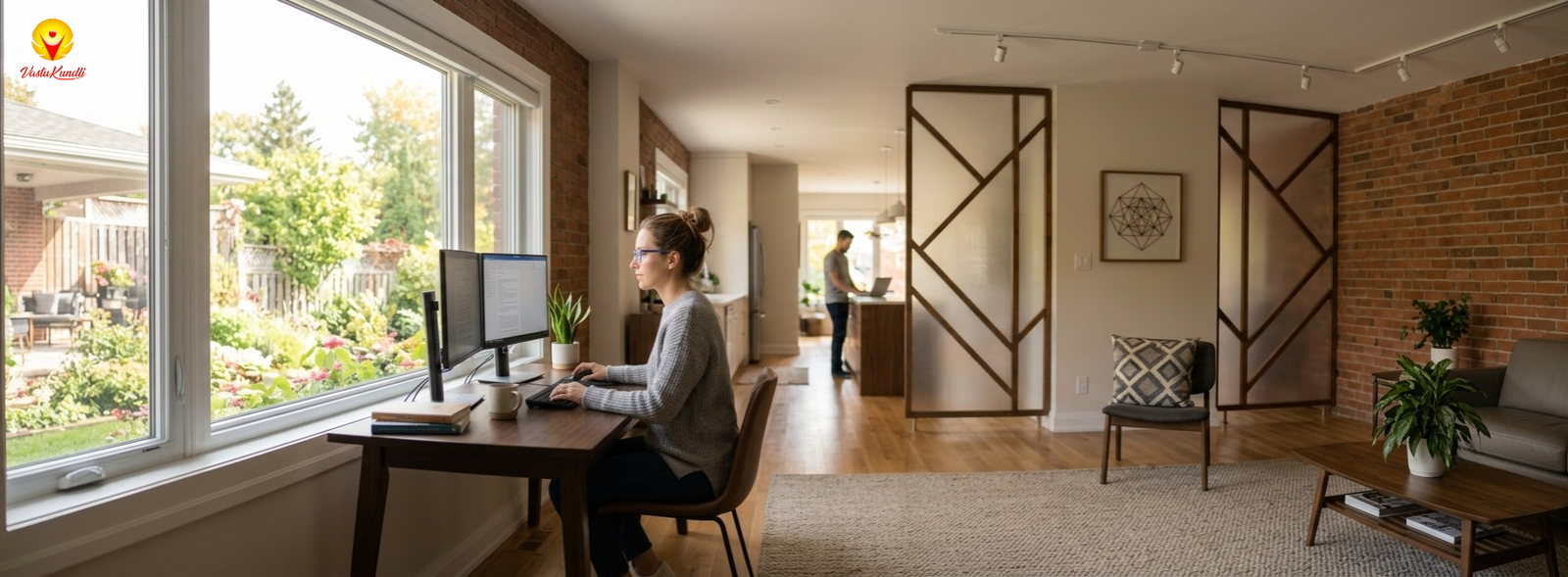
One of the most powerful and simple factors affecting your focus is the **direction you face** while working at your desk. This might sound arbitrary, but directional energies have been observed and documented for thousands of years. Modern research on geomagnetic fields and human cognition is starting to validate what ancient Vastu wisdom has always known about how directional orientation affects mental performance.
When you face certain directions while doing intellectual work, you’re aligning with energy patterns that enhance mental clarity, analytical thinking, and sustained concentration. When you face other directions, you might experience mental fogginess, increased distractibility, or a sensation of working uphill against resistance you can’t quite identify. The specific optimal direction varies somewhat based on the type of work you do and your individual energy, but certain general principles apply broadly.
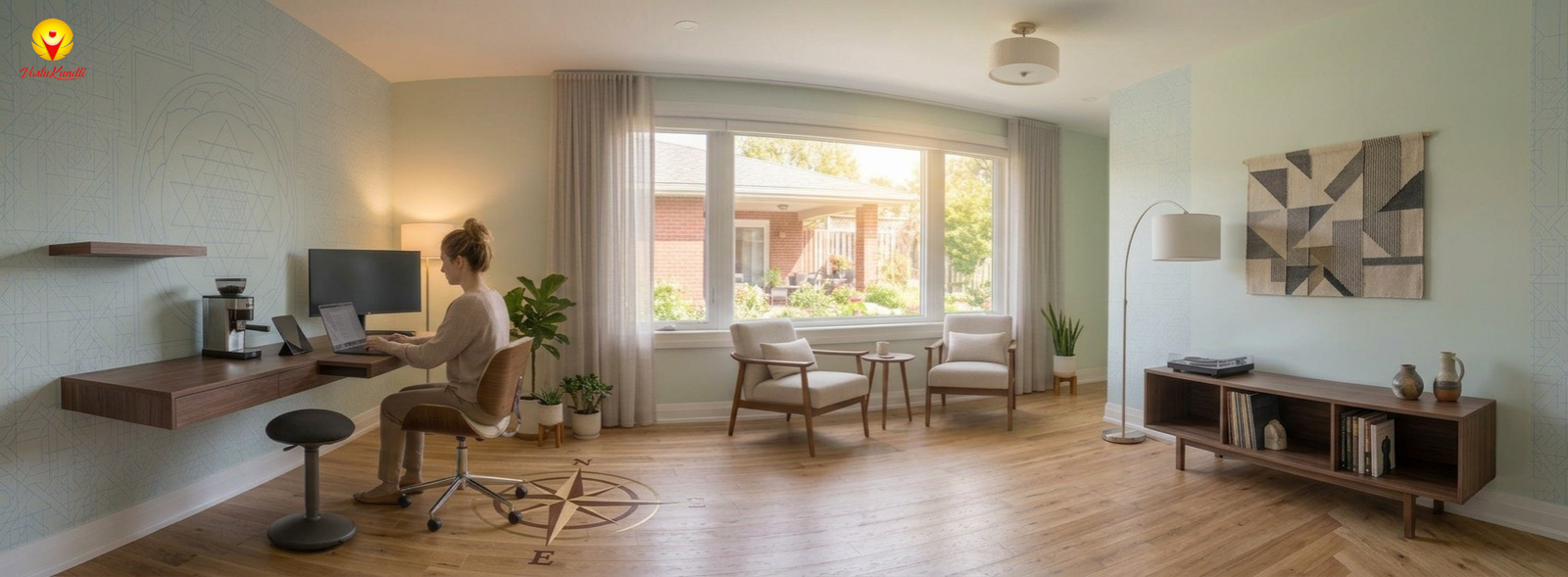
For Adarsh, his desk was positioned so that he faced West while working. For his specific work, which required deep analytical thinking and strategic planning, this directional orientation was creating **mental heaviness and reducing clarity**. He felt like his thoughts moved through molasses. Decisions that should be straightforward felt impossibly complicated. His creativity and problem-solving abilities, which had always been his strengths, seemed to have evaporated.
Simran faced North while working, which should theoretically support focus, but the combination of her desk’s placement in the bedroom and other factors created its own problems. The Vastu Health Report they eventually obtained recommended specific directional orientations for each of their workspaces based on their individual needs and the overall energy map of the house. Simply repositioning desks to face more supportive directions created **immediate noticeable improvements** in their ability to concentrate and think clearly.
#### Why Working from Your Bedroom Kills Productivity
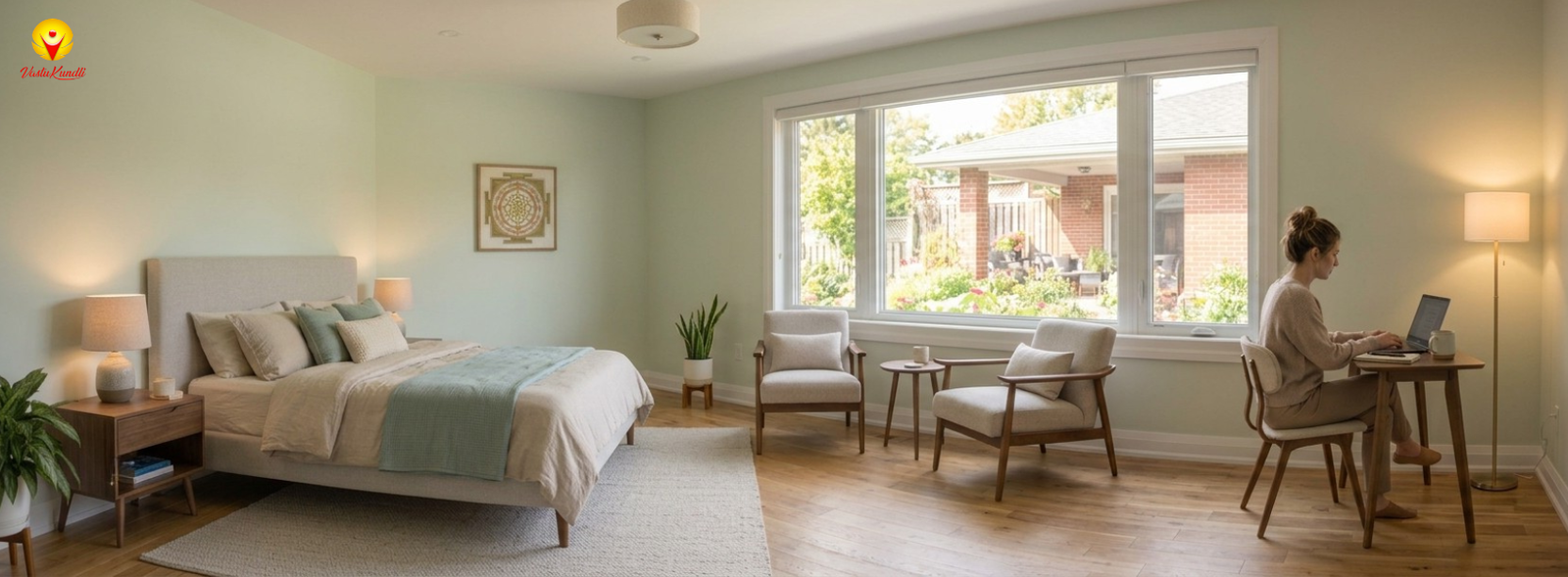
Many people working from home in North America, especially in apartments or smaller houses, set up workspaces in their bedrooms out of necessity. There might not be another option. But this creates a fundamental **energy conflict** that significantly impacts both work performance and sleep quality, creating a vicious cycle of declining productivity and increasing exhaustion.
Bedrooms are meant to be sanctuaries for rest, intimacy, and restoration. The energy in a bedroom should support downshifting from active consciousness to restful sleep. When you introduce a workspace into this room, you’re bringing active, productive, intellectual energy into a space designed for the opposite. This creates an energetic dissonance that affects both activities. Your brain gets confused about what this room is for, making it harder to focus while working and harder to relax while trying to sleep.
From a Vastu perspective, bedrooms occupy specific zones of a home that relate to rest and relationships, not intellectual productivity. When you try to do focused work in these zones, you’re working against the **natural energy purpose** of that space. It’s like trying to meditate in a gym or sleep in an office. The activity and the space are fundamentally mismatched.
Simran was experiencing this conflict acutely. Her corner desk in the bedroom meant she associated the room with work stress and deadlines rather than rest and relaxation. When she tried to sleep, her mind would start processing work problems because the room had become a work environment in her subconscious. When she tried to work, she felt the pull toward rest and disconnection because the room’s energy was fundamentally about restoration, not production. Neither activity happened effectively.
The Vastu recommendations included relocating her workspace out of the bedroom entirely, even if it meant a less aesthetically ideal setup in a different area. They repurposed a small alcove near the kitchen as her dedicated workspace, completely separating work energy from bedroom energy. The impact was dramatic. Her sleep quality improved within days, and her ability to focus during work hours increased substantially once she wasn’t fighting against the **bedroom’s restorative energy** while trying to be productive.
#### The Light Quality Factor Nobody Optimizes
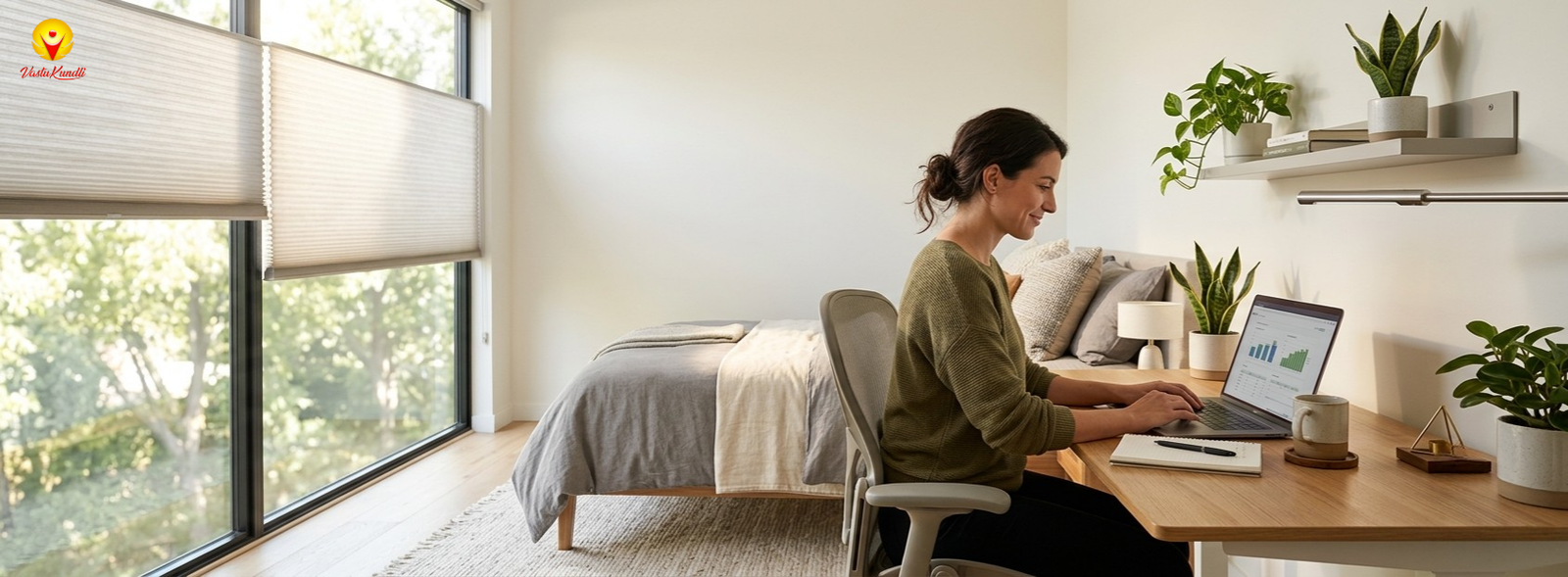
The quality, intensity, direction, and color temperature of light in your workspace profoundly affects your cognitive performance, yet most people never think about optimizing their workspace lighting beyond having enough brightness to see their screen. Natural light patterns, artificial light quality, and how light interacts with your directional orientation while working all influence your **mental clarity and energy levels** throughout the workday.
Insufficient natural light during daytime working hours can create a cave-like environment that suppresses alertness and mental energy. Your brain needs exposure to natural light to maintain proper circadian rhythms, which affect everything from hormone balance to cognitive sharpness. Working in a dim or artificially lit space all day disrupts these rhythms, leading to afternoon crashes, difficulty concentrating, and overall reduced mental performance.
Conversely, harsh direct sunlight creating glare on your screen or in your eyes creates visual stress that drains mental energy and reduces focus over time. The position of windows relative to your desk, the direction windows face, and how you manage natural light throughout the day all matter more than most people realize. Time of day matters too. Morning light from eastern windows energizes differently from afternoon light from western windows.
Adarsh’s workspace had a large window that let in beautiful natural light, which seemed like an asset. But the window faced West, meaning harsh afternoon sun would pour in during his typical peak productivity hours, creating glare and visual discomfort that forced him to close blinds and work in dimmer artificial light. This **light pattern disruption** was contributing to his afternoon slumps and reduced mental clarity in the second half of his workday.
The Vastu recommendations included strategic window treatments to filter afternoon light without blocking it entirely, repositioning his desk to reduce direct glare while maintaining natural light access, and adding full-spectrum artificial lighting that supplemented natural light rather than replacing it. These lighting optimizations created an environment where his eyes and brain could function **comfortably and alertly** throughout the entire workday.
#### Clutter as Cognitive Drain in Your Workspace
Physical clutter in your workspace creates mental clutter in your mind. This isn’t just metaphorical. Research on cognitive load shows that visual disorder in your environment consumes mental bandwidth as your brain constantly processes all the stimuli in your visual field. When your desk and immediate surroundings are cluttered with papers, objects, miscellaneous items, and visual chaos, a portion of your **cognitive resources** is always dedicated to managing that environmental disorder.
From a Vastu perspective, clutter creates energy stagnation. Energy that should flow smoothly through your workspace gets trapped in piles of stuff, creating pressure and heaviness in the space. This energetic congestion manifests as mental fog, difficulty thinking clearly, and reduced capacity for focused intellectual work. You can feel it when you walk into a cluttered room versus a clear, organized one, even if you’re not consciously analyzing why one feels heavy and the other feels light.
The challenge with workspace clutter is that it accumulates gradually when you’re busy and stressed, which is when you most need your environment to support rather than drain you. Papers pile up. Coffee cups multiply. Random objects migrate to your desk. Before you know it, you’re working surrounded by visual chaos that’s **actively undermining your productivity** every single day.
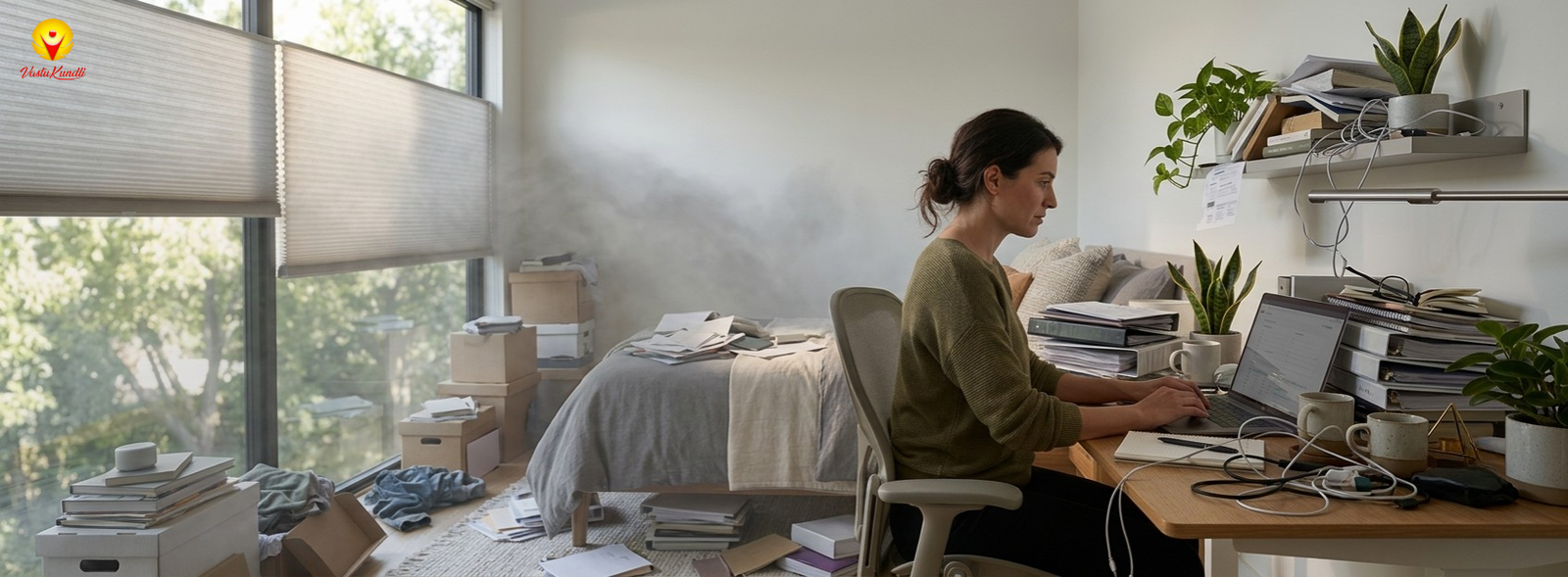
Both Adarsh and Simran had allowed their workspaces to become cluttered as they struggled with focus and fell behind on tasks. The clutter then made it even harder to focus, creating a negative feedback loop. The Vastu report specifically identified workspace clutter as a major factor affecting their productivity. The recommendation was thorough clearing and implementing systems to maintain organization going forward, not just one-time cleaning.
When they dedicated time to completely clearing and organizing their workspaces, removing everything except what was actively needed for current projects, both immediately felt a **mental lightness** they hadn’t experienced in months. Adarsh described it as his brain having more space to think. Simran said she could finally see her thoughts clearly instead of feeling mentally scattered. The physical clearing created mental clearing that translated directly into improved focus and output.
#### The Electronic Field Saturation Problem
Modern workspaces, especially home offices in North America, are saturated with electronic devices creating electromagnetic fields that affect sensitive individuals in ways that impact cognitive performance. Your computer, monitor, router, phone, printer, smart home devices, and all the wiring in walls create layers of **EMF exposure** that can contribute to mental fatigue, difficulty concentrating, and reduced cognitive clarity over extended periods.
Some people are more sensitive to EMF than others, but the cumulative effect of constant exposure throughout long workdays can affect anyone. Subtle symptoms like mental fog that clears when you leave the workspace, afternoon headaches, eye strain that seems disproportionate to screen time, or difficulty maintaining focus after several hours at your desk can all be related to **electromagnetic field exposure** in your work environment.
The positioning of your desk relative to walls with heavy electrical wiring, the proximity of your router to your workspace, whether you’re surrounded by multiple devices, and how many hours per day you’re exposed to these fields all contribute to your total EMF load. When this load is high, your nervous system expends energy managing the environmental stress, leaving less energy available for **cognitive performance**.
Adarsh had positioned his desk against a wall that happened to contain significant electrical wiring for the house. His router was on a shelf directly behind his monitor, about two feet from his head. His printer, external hard drive, phone charger, and tablet were all clustered on his desk, creating a dense field of electronics immediately surrounding him during all working hours. This **electronic saturation** was contributing to his mental fatigue and reduced clarity.
The Vastu recommendations included relocating the router to a different room farther from workspaces, repositioning his desk away from the wall with heavy wiring, and creating more space between him and his electronic devices where possible. These changes reduced his EMF exposure substantially. He noticed that the mental fog that typically descended by mid-afternoon started lifting, and his capacity for sustained focus improved noticeably.
#### Creating Energetic Boundaries Between Work and Life
When you work from home, especially in houses not originally designed with home offices in mind, creating clear **energetic boundaries** between work zones and living zones becomes critical for both productivity and quality of life. Without these boundaries, work energy bleeds into your entire home, making it feel like you’re always at work and never fully off duty. This constant activation makes it difficult to focus during work hours and impossible to relax during non-work hours.
In Vastu terms, different activities carry different energetic qualities and should ideally occupy different spatial zones. Work energy is active, intellectual, goal-oriented, and often somewhat stressful. Home energy should be restorative, connective, nurturing, and relaxed. When these energies mix without clear separation, neither functions optimally. Your home stops feeling like a refuge, and your workspace stops feeling like a place where focused productivity happens naturally.
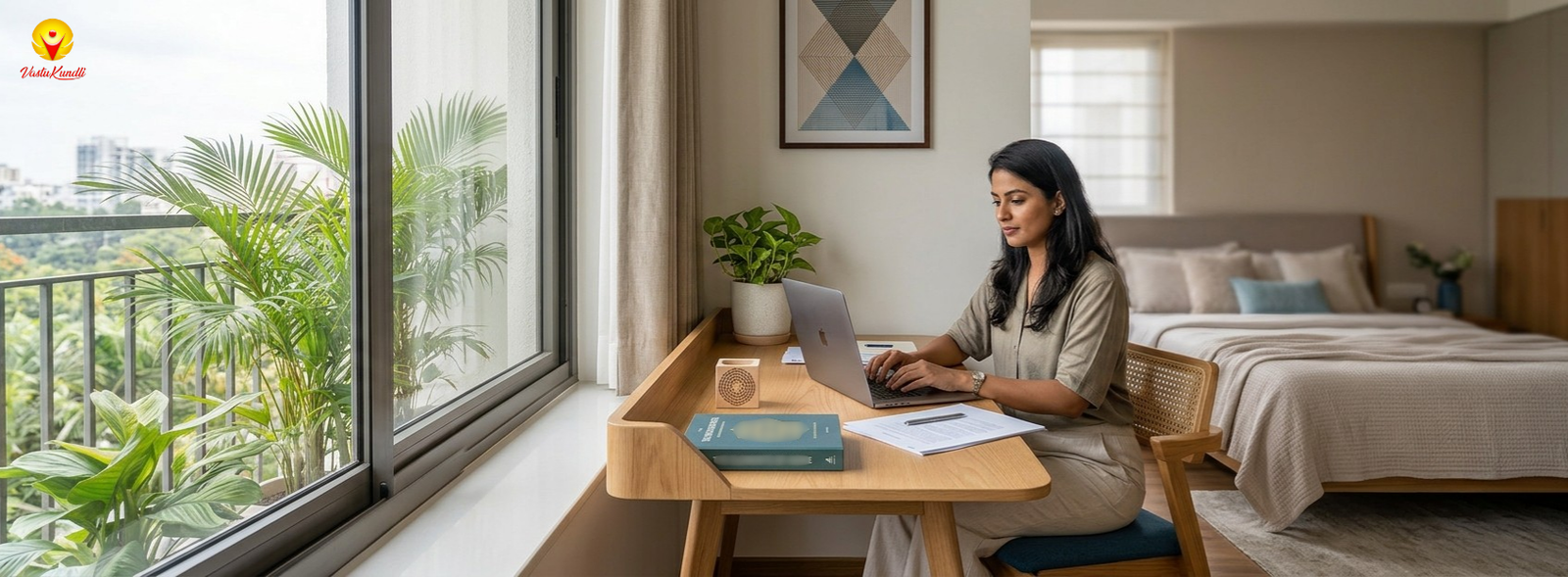
The solution isn’t necessarily a dedicated room with a door, though that’s ideal when possible. It’s about creating **clear spatial and energetic separation** between work activity and living activity, even in smaller spaces. This might mean positioning your desk in a way that faces away from living areas, using furniture or screens to create visual boundaries, establishing strict rules about not working outside the designated workspace, and creating transition rituals between work time and personal time.
For Adarsh and Simran, part of the challenge was that even after relocating Simran’s workspace out of the bedroom, both of their work setups were still visually and energetically present in living spaces all the time. They could see their desks and work materials from the couch, from the kitchen, everywhere. The **psychological weight** of work was constantly present in their home environment.
The Vastu recommendations included strategic positioning and design elements that created clearer boundaries. Adarsh’s workspace was repositioned to be visually separated from main living areas. They established a practice of completely clearing their desks at the end of each workday and covering them with specific cloths, creating a ritual that marked the transition from work to personal time. These boundaries helped them **psychologically and energetically separate** work from life, improving both their productivity during work hours and their ability to relax during personal time.
#### The Whole-Home Energy Support System for Focus
While workspace optimization is critical, your ability to focus and perform cognitively is also affected by the **overall energy quality** of your entire home. You’re absorbing the home’s general energy throughout evenings and weekends, which affects your baseline mental state and resilience. If the whole home has disturbed energy, even an optimized workspace can’t fully compensate for the background stress your system is managing.
The entrance energy affects your transition from the outside world to your home environment. If that transition is jarring or stressful, it affects your mental state for the rest of the evening and impacts how you start the next workday. The bedroom energy affects your sleep quality, which directly impacts cognitive performance. The kitchen and eating areas affect your physical health and energy levels. All of these zones working together create the foundation of **physical and mental well-being** that enables or undermines your capacity for focused, productive work.
This is why comprehensive Vastu analysis examines the entire home rather than just the workspace. The goal is to create a whole-home environment that supports your well-being generally, with specific optimizations in the workspace for productivity. When your home nurtures you during non-work hours, you come to your work tasks with **fuller energy reserves** and greater capacity for sustained focus and high-quality output.
For Adarsh and Simran, implementing workspace changes alone helped significantly, but implementing the full set of recommendations from their Vastu Health Report created compounding benefits. Better sleep from bedroom optimizations meant they started work less depleted. Improved entrance energy made coming home feel restorative rather than stressful. Decluttering throughout the house reduced their overall mental load. All these factors together created a **foundation of wellbeing** that supported their cognitive performance and productivity in ways that isolated workspace changes alone couldn’t achieve.
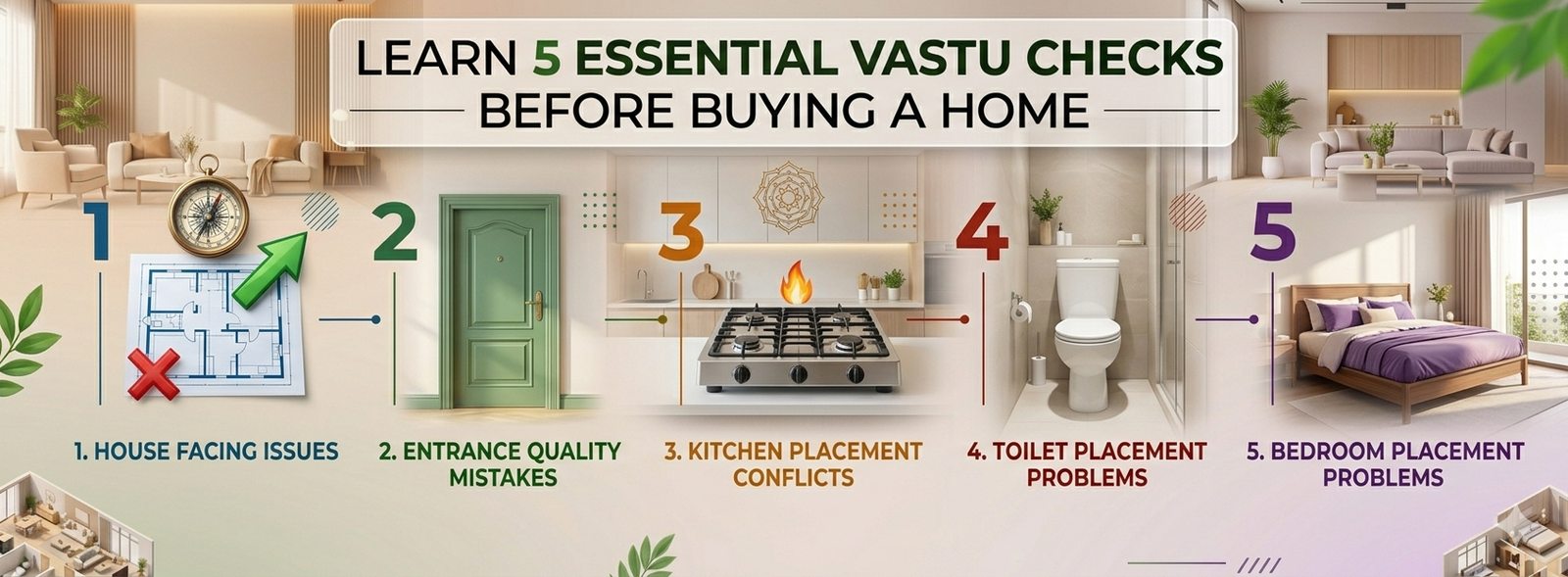
#### Learn 5 Essential Vastu Checks Before Buying a Home
Even before consulting an expert, families can perform 5 essential checks themselves:
- **House Facing Issues** – The direction your home faces affects overall energy and growth.- **Entrance Quality Mistakes** – The main door controls how positive energy enters the house.- **Kitchen Placement Conflicts** – Wrong kitchen direction can disturb health and finances.- **Toilet Placement Problems** – Poor toilet location can weaken wealth and health zones.- **Bedroom Placement Problems** – Incorrect bedroom zone can affect sleep and relationships.
These simple checks are just the start. To learn them in depth, with practical applications for homes in the USA and Canada:
**Join our live course “5 Essential Vastu Checks Before Buying a Home.”**
This course will guide you step-by-step to evaluate any property before making a purchase, helping you avoid mistakes that lead to stress, financial strain, and family discomfort. Families who take this course leave with actionable insights they can implement immediately—whether they’re buying a new home or checking an existing property.
**Go to the course section and join our live course today to gain major Vastu insights for every home decision.**
**[](https://vastukundli.com/product/vastukundli-online-masterclass/)**
#### Book Your Comprehensive Vastu Health Report
For families ready to buy or even after selecting a property, our Vastu Health Report is invaluable. Unlike a casual consultation, this report examines 30+ critical parameters of your home, including:
Main door alignment and entrance energy, kitchen orientation and placement, bedroom and study room energy, clutter and lighting analysis, and hidden energy zones affecting health, wealth, and relationships.
By checking all these parameters, families can identify and correct energy blockages before moving in, ensuring long-term harmony, prosperity, and well-being.
**Book your personalized Vastu Health Report in the consultation section today—because your home should nurture your family, not drain it.**
**[](https://vastukundli.com/product/vastu-health-report/)**
#### About Our Vastu Expert – Gaurav Jindl
With extensive experience helping remote workers and families throughout USA and Canada, Gaurav Jindl specializes in practical Vastu solutions for modern North American homes. He understands the unique challenges of working from home and how environmental energy affects cognitive performance and productivity. His recommendations focus on simple, achievable remedies that work within Western home design without requiring renovations or structural changes.
#### Practical Advice for Families in the USA and Canada
If you’re struggling with focus and productivity while working from home, don’t immediately assume you lack discipline or are experiencing burnout. Consider your workspace environment as a significant factor. Start by observing patterns. Do you feel more alert and focused at certain times of day? Does your mental clarity improve when you work from different locations? Do you feel drained after several hours at your desk?
Simple first steps include completely decluttering your workspace and keeping it rigorously organized. Ensure you have adequate natural light during daytime working hours supplemented with quality artificial lighting. Position your desk to face a direction that feels supportive for concentration. If possible, avoid working from your bedroom. Remove or distance electronic devices that aren’t essential for your immediate work tasks.
If productivity challenges persist despite these basic environmental improvements, invest in a comprehensive Vastu Health Report that analyzes your specific home’s energy patterns and their effects on cognitive performance. The workspace optimizations and whole-home recommendations can transform your ability to focus and produce quality work from home.
**[](https://vastukundli.com/product/initial-vastu-consultation/)**
#### Final Thoughts
Adarsh and Simran’s story represents countless professionals working from home in USA and Canada who struggle with productivity and blame themselves when the real issue is environmental. The frustration of underperforming despite genuine effort, the stress of falling behind on work, the fear of losing your professional edge—all of this creates real pain and anxiety. But sometimes the solution isn’t working harder or managing time better. Sometimes your workspace energy is undermining your cognitive performance in ways that make focused work unnecessarily difficult.
Your home environment profoundly affects your mental clarity, focus capacity, and intellectual performance. When your workspace energy works against you, productivity becomes a constant battle that drains your confidence and well-being. When you optimize your workspace and whole-home energy to support cognitive performance, focused work can feel natural and effortless again.
Don’t accept struggling with focus as a personal failing before examining your environment. Your workspace deserves as much attention as your work habits because they’re deeply interconnected. The space where you work every day shapes your capacity to perform at your best.
#### Frequently Asked Questions
**Q. Can workspace energy really affect my ability to focus and be productive?**
Yes, absolutely. Environmental factors, including directional orientation, light quality, EMF exposure, clutter levels, and zone energies, all affect your cognitive performance in measurable ways. Your brain is highly sensitive to environmental inputs that influence mental clarity, sustained attention, and intellectual output.
**Q. How quickly might I notice productivity improvements after workspace changes?**
Most people notice initial improvements within several days to two weeks, particularly in sustained focus capacity and reduced mental fatigue. More substantial productivity gains typically develop over four to six weeks as you consistently work in an optimized environment and experience cumulative benefits.
**Q. What if I don’t have a dedicated room for a home office?**
Most people working from home don’t have dedicated office rooms. Vastu solutions focus on optimizing whatever workspace you have, even corners of rooms or alcoves. The key is creating clear, energetic and visual boundaries between work zones and living zones, regardless of whether you have a separate room.
**Q. Do these remedies work for creative work or only analytical tasks?**
Vastu principles apply to all types of intellectual work, including creative, analytical, strategic, and technical tasks. The specific directional orientations and environmental factors that optimize different work types vary somewhat, which is why personalized analysis based on your specific work needs produces the best results.
**Q. Can I improve my workspace while renting and unable to make permanent changes?**
Yes, most effective workspace optimizations don’t require structural modifications. Desk positioning, lighting improvements, clutter management, EMF reduction, and strategic use of colors and objects all work perfectly in rental situations and are completely reversible when you move.

---
_View the original post at: [https://vastukundli.com/how-home-energy-affects-focus-and-productivity/](https://vastukundli.com/how-home-energy-affects-focus-and-productivity/)_
_Served as markdown by [Third Audience](https://github.com/third-audience) v3.5.2_
_Generated: 2026-06-30 07:42:54 UTC_