
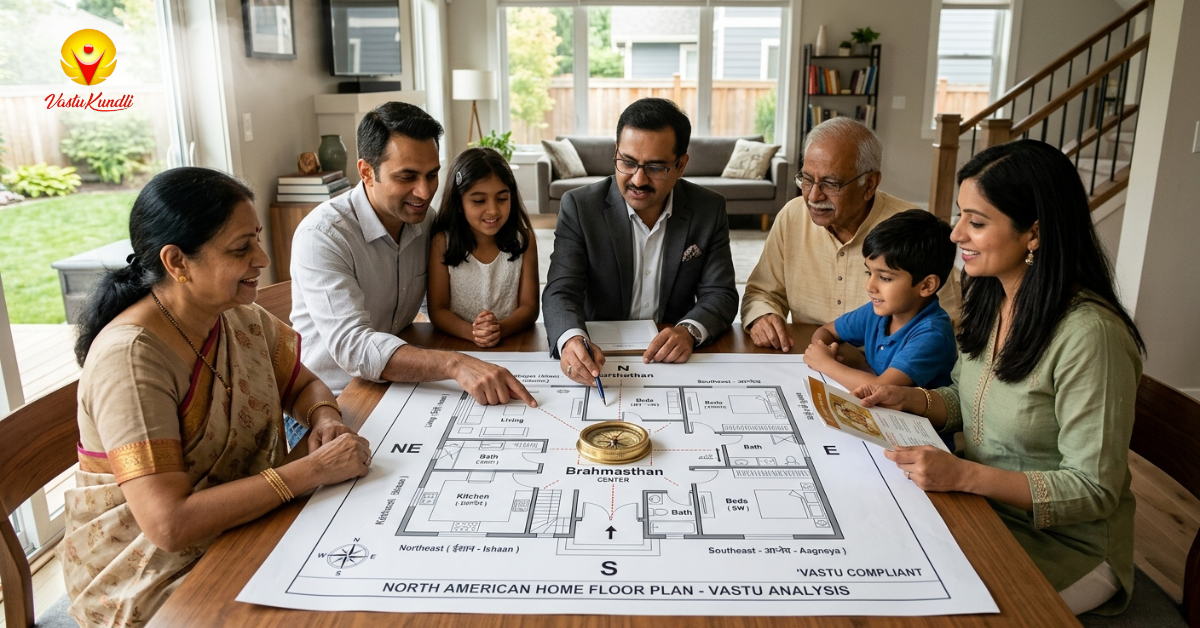
Rishabh and Anika stood in front of their dream home in suburban Chicago, feeling completely torn. The house had everything they wanted. Four bedrooms for their growing family. A beautiful backyard where their kids could play. It was in their budget and located in an excellent school district. But their parents back in India had one major concern after seeing the floor plan. The main entrance faced southwest, and the kitchen was in the northwest corner. Their mother insisted they walk away immediately, saying no home is worth inviting bad energy. Rishabh and Anika didn’t know what to do. Should they reject a property they loved because of Vastu issues, or were they overthinking things that could be fixed?
This dilemma faces thousands of Indian families across the USA and Canada every year. You find a home that checks all the practical boxes, but then Vastu concerns create doubt and confusion. Your parents warn you about directional problems. You read conflicting information online. Some people tell you Vastu doesn’t matter in Western countries, while others insist it’s absolutely critical. You’re stuck between modern practicality and traditional wisdom, unsure whether to walk away from a good property or move forward despite the concerns.
The honest answer is that not all Vastu issues are deal breakers, but some definitely are. Understanding the difference can save you from two equally bad outcomes. Rejecting a perfectly good home that just needs minor adjustments or buying a property with fundamental problems that will drain your family’s energy and happiness for years to come. The key is knowing which concerns are serious enough to reject a property and which can be corrected or managed effectively.
Understanding the Difference Between Major and Minor Vastu Issues
Not all Vastu defects carry the same weight. Some problems are fundamental structural issues that can’t be changed without massive renovations that cost more than the house is worth. Other issues are minor placement concerns that can be corrected with simple adjustments, room purpose changes, or energy remedies that don’t require breaking walls or moving plumbing.
Major Vastu defects include things like severe directional misalignment of the entire structure, having toilets in the center of the home, which is called the Brahmasthan, or having the main entrance and back door in direct alignment, creating energy that rushes straight through without circulating. These are serious problems because they affect the fundamental energy structure of the entire property, and fixing them usually requires major construction that most families can’t afford or aren’t permitted to do, especially in condos or rental properties.
Minor Vastu concerns might include things like bedroom colors, furniture placement, or the direction a stove faces. These don’t require structural changes. You can address them by changing which room serves which purpose, moving furniture around, using specific colors or materials, or adding certain elements that balance the energy. The house structure stays the same, but you optimize how you use the space.
The problem is that most families don’t know which category their specific concerns fall into. They treat every Vastu issue with equal alarm, assuming that any defect means the home is cursed or will bring bad luck. This leads to rejecting homes unnecessarily or worse yet buying homes with real problems while ignoring them because they’re exhausted from overthinking every little detail.
When You Should Absolutely Walk Away
There are certain situations where rejecting a property is the right decision, no matter how much you love other aspects of it. If the toilet is located in the Brahmasthan or center of the home, this is a fundamental flaw that affects the entire property’s energy. The center is considered the heart of the home, and having a bathroom there creates problems that can’t be adequately fixed without major renovation.
Similarly, if the main entrance and back exit are in perfect alignment, creating what’s called a piercing energy flow, you should seriously reconsider. This setup causes positive energy to enter and immediately exit without circulating through the home. Families in such homes often struggle to retain wealth, feel constantly restless, and find that opportunities come but don’t stick around long enough to benefit them.
Properties with multiple major structural defects should also be rejected, especially if you’re buying rather than renting. If the house faces the wrong direction and has the kitchen in a problematic zone, has toilets above bedrooms, and has the master bedroom in an inauspicious corner, you’re looking at a property that would require extensive renovation to make livable from an energy perspective. The cost and effort would exceed any initial savings from a lower purchase price.
Another red flag is when your gut feeling strongly resists a property even after you’ve evaluated it logically. Sometimes you walk into a house and immediately feel uncomfortable, heavy, or anxious. This isn’t superstition. You’re picking up on energy imbalances that your conscious mind might not identify, but your body senses clearly. Trust that instinct, especially when combined with Vastu defects.
When Problems Can Be Fixed or Managed
Many Vastu concerns are completely manageable without rejecting the property. Wrong bedroom placement can often be solved by changing which room serves which purpose. If the master bedroom is in a zone that’s not ideal for couples, you might use that room as a home office or guest room instead and use a different bedroom as the master suite.
Kitchen direction issues can sometimes be addressed by changing the stove placement or cooking direction rather than moving the entire kitchen. If the kitchen is in the northwest, which isn’t ideal, you can’t relocate it without major plumbing and electrical work. But you can adjust how you arrange the cooking area within that space to minimize negative effects.
Entrance direction problems are among the most fixable Vastu issues. If your main entrance faces a challenging direction but the house is otherwise sound, you can create a secondary entrance that you use as your primary entry point. Many North American homes have garage entries that families use more than the front door anyway. By designating your most-used entrance as the main entry energetically, you can work around architectural entrance placement.
Even some major concerns can be balanced with strategic remedies if the property has enough positive factors to offset them. A home with good overall energy flow, natural light throughout, and proper room proportions can handle minor directional issues better than a home that’s already compromised in multiple ways. It’s about evaluating the complete picture rather than fixating on individual problems.
Evaluating the Complete Property Picture
Smart families look at Vastu as one factor among many rather than the only factor. A home with perfect Vastu but located in an unsafe neighborhood with failing schools and a long commute isn’t actually a good choice. Similarly, a home with minor Vastu issues but excellent location, strong structure, and good layout might be worth buying with plans to make adjustments.
Consider your financial reality and renovation capacity. If you’re stretching your budget just to afford the purchase price, you shouldn’t buy a home that needs immediate major Vastu corrections. But if you have a financial cushion and renovation skills or budget, then a home with fixable issues might be a good investment, especially if the Vastu concerns are keeping the price lower than comparable properties.
Think about your timeline and flexibility. If you’re renting and can move in a couple of years, then even a property with some Vastu challenges might work temporarily while you search for something better. But if you’re buying your forever home, where you plan to raise children and retire, you need to be much more careful about accepting properties with significant defects.
Also, evaluate whether you’re willing to make lifestyle adjustments. Some Vastu corrections require changing how you use spaces or where family members sleep. If you’re flexible about these things, many problems become solvable. If you’re rigid about wanting specific rooms for specific purposes, you’ll have less ability to work around layout issues.
The Role of Modern Architecture in Vastu Decisions
North American homes present unique challenges and opportunities when it comes to Vastu evaluation. Open floor plans, which are very popular in modern construction, create different energy dynamics than traditional separated rooms. Basements are common in Canada and the northern USA, adding levels that ancient Vastu texts didn’t address. Attached garages change how families actually enter their homes daily.
These architectural differences mean you can’t apply traditional Vastu rules rigidly. A consultant who understands North American construction is essential because they can interpret principles in context rather than just checking directional charts. What matters in a Toronto townhouse differs from what matters in a traditional Indian bungalow, even though the underlying energy principles remain the same.
Modern building codes and homeowner association rules also limit what changes you can make. You might not be allowed to add a new entrance, remove walls, or make exterior modifications, even if those would solve Vastu problems. Understanding these restrictions before you buy helps you avoid purchasing a property where you can’t implement necessary corrections.
Learn 5 Essential Vastu Checks Before Buying a Home
Even before consulting an expert, families can perform 5 essential checks themselves:
- House Facing Issues – The direction your home faces affects overall energy and growth.
- Entrance Quality Mistakes – The main door controls how positive energy enters the house.
- Kitchen Placement Conflicts – Wrong kitchen direction can disturb health and finances.
- Toilet Placement Problems – Poor toilet location can weaken wealth and health zones.
- Bedroom Placement Problems – An incorrect bedroom zone can affect sleep and relationships.
These simple checks are just the start. To learn them in depth, with practical applications for homes in the USA and Canada:
Join our live course “5 Essential Vastu Checks Before Buying a Home.”
This course will guide you step-by-step to evaluate any property before making a purchase, helping you avoid mistakes that lead to stress, financial strain, and family discomfort. Families who take this course leave with actionable insights they can implement immediately, whether they’re buying a new home or checking an existing property.
Go to the course section and join our live course today to gain major Vastu insights for every home decision.
Book Your Comprehensive Vastu Health Report
For families ready to buy or even after selecting a property, our Vastu Health Report is invaluable. Unlike a casual consultation, this report examines 30-plus critical parameters of your home, including main door alignment and entrance energy, kitchen orientation and placement, bedroom and study room energy, clutter and lighting analysis, and hidden energy zones affecting health, wealth, and relationships.
By checking all these parameters, families can identify and correct energy blockages before moving in, ensuring long-term harmony, prosperity, and well-being.
Book your personalized Vastu Health Report in the consultation section today because your home should nurture your family, not drain it.
About Our Vastu Expert – Gaurav Jindl
Gaurav Jindl has spent over twenty years helping Indian families across North America navigate the balance between traditional Vastu wisdom and modern Western architecture. His approach is practical rather than rigid, understanding that families need solutions that work with North American building styles, budgets, and lifestyles.
What makes Gaurav different is his ability to distinguish between deal-breaker defects and manageable concerns. He won’t tell you to reject every property with any Vastu issue because that’s unrealistic in the North American housing market. Instead, he provides an honest assessment of which problems are serious, which can be corrected, and what those corrections will realistically cost in time and money.
Families working with Gaurav learn to evaluate properties confidently rather than living in constant fear of making the wrong choice. He teaches the principles behind the rules so you understand why certain placements matter and can make informed decisions rather than just following blind instructions. His consultations empower families to find homes that support their well-being without rejecting every option out of unnecessary fear.
Practical Advice for Families in the USA
When house hunting in the USA and Canada, make Vastu evaluation part of your process, but not the only factor. Create a checklist that includes location, price, structure, schools, commute, and Vastu concerns. Rank which factors matter most to your family specifically. This helps you make balanced decisions rather than fixating on one aspect.
Get a professional evaluation before rejecting a property you otherwise love. What seems like a major Vastu problem to you might be easily correctable according to someone with expertise. Don’t rely on free online charts or advice from family members who aren’t familiar with North American construction. Invest in proper consultation before walking away from a good opportunity.
Remember that perfect Vastu homes are extremely rare, especially in the North American market, where builders don’t design with these principles in mind. If you’re waiting for a property with zero Vastu concerns, excellent location, and perfect price, you might be searching for years. Learn to identify which imperfections you can live with or correct versus which are true deal breakers.
Final Thoughts
The question of whether to reject a home due to Vastu concerns doesn’t have a simple yes or no answer. It depends on the severity of the defects, your ability to correct them, and how the property performs on other important factors. The goal isn’t to find a perfect home because that doesn’t exist. The goal is to find a home that’s good enough in all the ways that matter to your family, with defects that are either minor or manageable.
Rishabh and Anika eventually bought that Chicago home. They consulted with an expert who confirmed that while the entrance direction wasn’t ideal, the house had good overall energy flow, and the kitchen placement could be optimized with some adjustments. They used their garage entrance as their primary entry point, rearranged the kitchen workspace, and made a few other minor changes. Three years later, they’re thriving in a home they love in a neighborhood that’s perfect for their family.
Don’t let fear of Vastu defects prevent you from buying a home that’s otherwise right for your family. But also don’t ignore genuine red flags just because you’re tired of searching or emotionally attached to a property. Get educated, consult with knowledgeable experts, and make decisions based on complete information rather than anxiety or blind tradition.
Frequently Asked Questions
Q. Should I reject a home just because the main entrance faces southwest?
A. Not automatically. The Southwest entrance can be balanced with corrections, and if the rest of the home has good energy, it might still be a solid choice. Evaluate the complete property, not just one factor.
Q. Can Vastu defects really affect my family, or is it just superstition?
A. Energy flow in homes affects well-being, whether you call it Vastu, feng shui, or building science. Poor layouts create problems in any cultural framework. Good Vastu aligns with practical design principles that support healthy living.
Q. What if I already bought a home and then discovered Vastu problems?
A. Many problems can be corrected after purchase through room purpose changes, furniture arrangements, and energy remedies. Get a comprehensive report to identify what can be fixed and prioritize the most impactful changes.
Q. Are Vastu rules different for homes in North America versus India?
A. The underlying principles remain the same, but the application differs based on architectural styles, climate, and building codes. You need a consultant who understands both traditional Vastu and modern Western construction.
Q. How much should I spend on Vastu corrections before it makes more sense to find a different property?
A. If corrections would cost more than twenty percent of the home’s value or require changes you’re not permitted to make, you should probably keep searching. Minor adjustments under a few thousand dollars are usually worth making for an otherwise good home.
