
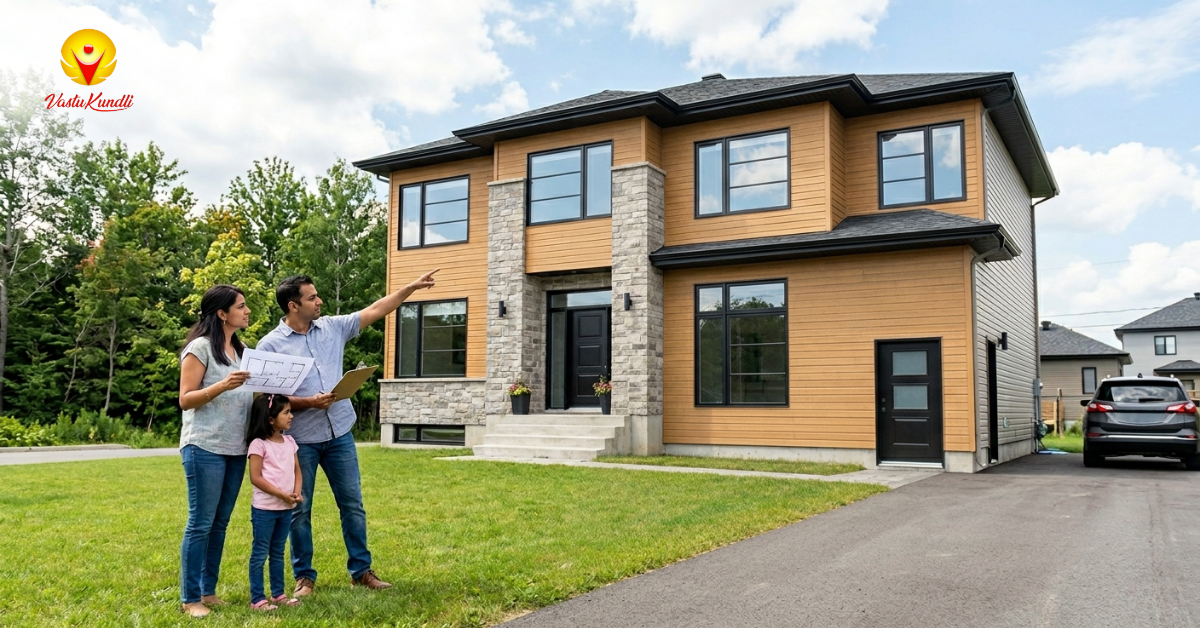
Indian families moving to North America bring deep cultural wisdom about creating harmonious living spaces. They understand intuitively that homes are more than just physical structures, that the energy within four walls affects everything from health and relationships to career success and financial prosperity. Yet when these same families start house hunting in the USA or Canada, they make Vastu mistakes they would never make back home. These aren’t errors of ignorance but rather miscalculations that happen when traditional knowledge meets unfamiliar modern Western architecture.
The North American housing market operates completely differently than what most Indian families experienced in their home country. Open concept floor plans, attached garages, finished basements, split-level designs, these architectural features don’t exist in traditional Vastu texts. Families don’t know how to evaluate these modern elements through a Vastu lens. They also face time pressure from competitive markets, emotional overwhelm from too many choices, and advice from real estate agents who have zero understanding of energy principles. All of this creates a perfect storm for making decisions that look good on paper but create energy problems for years to come.
Tarun and Nandini experienced this firsthand when relocating to Vancouver for Tarun’s job. They were educated, successful professionals who absolutely believed in Vastu principles. Back in Bangalore, they had consulted experts before renting apartments and always paid attention to directional placement. But in Vancouver’s hot real estate market, they felt rushed. They found a beautiful house in their budget with good schools nearby and made an offer within 48 hours without proper Vastu evaluation. They told themselves they’d fix any issues after moving in.
Six months later, they were living with consequences they hadn’t anticipated. The southwest entrance they’d overlooked was limiting Tarun’s career advancement despite excellent performance at work. The master bedroom in the northwest zone created restless sleep and subtle relationship tension. The open floor plan they’d loved in photos was causing energy to rush through the house creating constant feelings of instability and scattered focus. They had made classic mistakes that thousands of Indian families make every year when buying North American homes, mistakes that are completely preventable with the right knowledge and approach.
Ignoring Entrance Direction in Favor of Curb Appeal
The most common and consequential mistake families make is prioritizing how the front of the house looks over which direction it actually faces. They fall in love with beautiful landscaping, an impressive facade, or charming architectural details while completely overlooking that the main entrance sits in an energetically challenging direction that will affect their lives daily.
North American real estate marketing emphasizes curb appeal heavily. Builders and agents know that the exterior appearance drives emotional reactions and quick offers. Families touring properties notice the pretty front door, the well-maintained lawn, the attractive porch, all the visual elements. What they don’t check is whether that beautiful entrance faces south, southwest, or west directions that require careful consideration and often correction strategies in Vastu practice.
The problem compounds because many modern developments orient houses based on street layout and lot configuration not on optimal directional alignment. Builders rotate the same floor plan to fit different lots meaning your dream home design might face an unfavorable direction simply because of which lot you’re purchasing. Families assume builders considered directional factors but they absolutely did not. The entrance faces wherever it needs to face the street and that’s the end of the builder’s directional thinking.
Another layer of confusion comes from multiple potential entrances in North American homes. There’s the architectural front door facing the street. There’s often a side door from the driveway or garage. Many homes have back patio entrances. Families tour properties noting these various doors but don’t determine which entrance they’ll actually use daily and whether that functional main entrance sits in a supportive direction. They might notice the front door faces south but plan to enter daily through the garage door and never evaluate what direction that garage entrance occupies.
The emotional pull of a beautiful exterior overrides analytical directional checking. When you see a house that looks exactly how you imagined your dream home would look, it’s incredibly difficult to walk away because the entrance faces a challenging direction. Families tell themselves the direction doesn’t matter that much or that they’ll correct it somehow later. But entrance direction affects how energy enters your home daily and influences every aspect of life within those walls. No amount of beautiful landscaping compensates for an entrance that limits growth and opportunity.
Falling for Open Concept Without Checking Energy Flow
The second major mistake is getting seduced by trendy open concept layouts without understanding how these designs affect energy circulation from a Vastu perspective. Open floor plans are heavily marketed as desirable modern features. Every new construction development touts open living spaces. Real estate agents emphasize how open designs make homes feel larger and encourage family interaction. Families touring these properties see the spacious feel and imagine hosting gatherings in these flowing spaces.
What they miss is that extreme openness creates energy rushing where positive flow enters through the main door and shoots straight through to the back without slowing down to nourish different zones of the home. Traditional Vastu principles developed in context of homes with defined rooms separated by walls and doorways. These barriers naturally slow energy and allow it to settle in different areas serving different functions. Open concepts remove these barriers creating a completely different energy dynamic.
Families see floor plans showing kitchen, dining, and living areas as one continuous space and think this looks functional and attractive. They don’t recognize that this layout creates piercing energy especially when the front entrance and back exit align with sightlines straight through the house. Energy enters and immediately rushes out the back without circulating through your living zones. This manifests as difficulty retaining wealth, constant restlessness, opportunities that come and go without materializing, and general feeling of instability.
The kitchen visibility issue compounds in open layouts. Many open concept designs position the kitchen such that the cooking area is directly visible from the main entrance. Families don’t realize this exposes the fire element of cooking to entering energy creating conflicts. They see the beautiful kitchen island and granite countertops without considering the energetic implications of that stove being the first thing energy encounters when entering the home.
Another open concept problem is lack of defined private versus public zones. Traditional homes have clear separation between areas where you receive guests and areas reserved for family intimacy and rest. Open plans blur these boundaries. Your bedroom hallway might be visible from the living room. Your morning kitchen routine happens in full view of anyone in the adjoining family room. This absence of energetic boundaries affects family dynamics in ways families don’t anticipate until they’re living there.
Overlooking Bathroom Placements in Critical Zones
Perhaps the most overlooked mistake is failing to carefully check every bathroom location against the directional grid before finalizing a purchase. North American homes typically have multiple bathrooms unlike many traditional Indian homes where bathroom evaluation focused on a single location. Families touring properties note that a home has three bathrooms or four bathrooms, treating this as a quantity feature without evaluating where each bathroom sits directionally.
The most critical check is whether any bathroom occupies the Brahmasthan or center zone of the home. This is a fundamental Vastu defect that affects the entire property’s energy. Many older North American homes were designed with central bathrooms for plumbing efficiency creating exactly this problem. Families walk through homes admiring finishes and layout without determining where the center actually falls and whether waste energy sits there draining the heart of the home.
Bathrooms in the northeast are another serious concern families miss. The northeast is associated with spiritual energy, clarity, and financial opportunities. Having a bathroom there creates drainage in this critical zone. Families might notice a bathroom in that general area but don’t pull out a compass or check the floor plan carefully enough to confirm it’s actually in the northeast quadrant. They assume it’s close enough to north or east to be acceptable without understanding the specific northeast zone carries particular importance.
Similarly bathrooms in the north affect wealth accumulation and career growth. The north is connected to financial prosperity and professional opportunities. Toilets in this zone create drainage that manifests as money flowing out as fast as it comes in or career stagnation despite skills and effort. Families focused on bathroom size, fixtures, and finishes don’t check directional placement rigorously enough to catch this problem before purchase.
The master bedroom ensuite placement within the bedroom space also goes unchecked. North American master bedrooms almost universally include attached bathrooms. Where this bathroom sits relative to where the bed will be positioned matters significantly. A bathroom directly in line with the bed creates drainage. Bathrooms occupying large portions of the bedroom space in critical directions drain relationship energy. Families see a large luxurious master bath as a positive feature without evaluating its specific placement within the room.
Accepting Bedrooms Over Garages Without Question
North American architecture commonly places bedrooms directly over attached garages using the space above the garage efficiently from a builder’s perspective. This creates an energetic situation that doesn’t exist in traditional construction and families don’t recognize it as problematic because they’ve never encountered it before and Vastu texts don’t specifically address it.
Sleeping over an empty void with vehicle energy and fumes below disrupts the solid earth foundation that should support rest and grounding. The garage is a space for machines and movement, not for stillness and rejuvenation. Having your bedroom above this area creates energetic instability that affects sleep quality, health, and general sense of security. Children’s bedrooms over garages can contribute to restlessness, difficulty concentrating, and feeling ungrounded.
Families touring homes notice which rooms are bedrooms and roughly where they’re located. They might even prefer the bedroom over the garage because it’s often larger with nice features. What they don’t do is specifically check whether any bedroom sits above the garage space and consider the energy implications. They see it as a room like any other rather than recognizing the void beneath creates different conditions than bedrooms with solid foundation below.
The floor plan usually reveals this placement if you compare first and second floor layouts carefully. The garage footprint on the first floor plan corresponds to what’s above it on the second floor. But families looking at floor plans focus on room sizes and bathroom access rather than checking vertical relationships between floors. Even when they notice a bedroom is above the garage, they don’t understand why this matters energetically.
This mistake is especially common in townhouses and newer suburban homes where builders maximize usable space by building up over garages. In competitive markets, families feel pressure to act quickly on any acceptable property. They don’t take time to carefully evaluate vertical relationships and might not even request floor plans for both levels before making offers. The bedroom over garage issue goes completely unnoticed until they’re living there and experiencing unexplained fatigue or sleep problems.
Choosing Based on Square Footage Instead of Zone Quality
Families get caught up in the North American obsession with square footage using total size and number of bedrooms as primary decision factors while ignoring which directional zones those rooms actually occupy. Real estate listings emphasize square footage prominently. Bigger is marketed as better. Families compare homes based on these numbers rather than evaluating the quality of the spaces from an energy perspective.
A large master bedroom in the northwest zone doesn’t serve your relationship as well as a smaller master bedroom in the southwest regardless of the size difference. But families see that one house has a 200 square foot master and another has a 150 square foot master and prefer the larger one without checking which direction either bedroom occupies. They prioritize quantity over energetic quality.
The same mistake happens with additional bedrooms and bonus rooms. Families want four bedrooms instead of three because it sounds better and provides flexibility. They don’t consider whether that fourth bedroom sits in a zone that will actually support whoever uses it or whether it creates problems. A home with three well-placed bedrooms in supportive zones serves a family better than a home with four bedrooms where one or more occupy challenging directions.
Kitchen size also gets evaluated by square footage rather than directional placement and energy flow. Families love large modern kitchens with islands and eating areas. They compare kitchen sizes between properties choosing based on how much counter space and storage they’re getting. Meanwhile they ignore whether that beautiful large kitchen sits in the southeast where fire element aligns naturally or in the northwest where it creates health and financial instability.
Living area square footage receives similar focus. Families want open spacious living rooms and family rooms. They choose homes with larger public spaces without evaluating how energy moves through those spaces or whether the size comes at the expense of proper room placement. A smaller living area with good energy circulation and supportive directional alignment creates better family experiences than a massive living space where energy rushes through without settling.
Trusting Builder Reputation Over Energy Evaluation
Many families make the mistake of assuming that reputable builders or expensive properties automatically have good energy design. They think that builders who charge premium prices or have positive reputations must be creating quality homes in every sense, including energy efficiency. This is a dangerous assumption because builders have zero awareness of Vastu principles, regardless of their reputation for construction quality.
A custom builder with excellent craftsmanship still designs based on aesthetics, building codes, and functional space planning, not on directional alignment and energy flow. Their reputation reflects quality materials and skillful construction but says nothing about whether the layouts they create support family wellbeing energetically. Families touring expensive custom homes assume the high price tag means everything is optimized, including energy, when in fact the builder never considered Vastu at all.
Similarly, new construction developments by major national builders get assumed to be safe because these companies build thousands of homes and surely must know what they’re doing. But these builders use standardized plans repeated across developments. They optimize for construction efficiency and visual appeal in photos. Energy principles aren’t part of their design criteria no matter how many homes they build or how polished their marketing materials are.
Families also trust real estate agents as authorities on what makes a good home. Agents certainly know the local market, pricing trends, and neighborhoods. But they know absolutely nothing about Vastu or energy flow. When an agent enthusiastically recommends a property or assures you it’s a great house, they’re evaluating resale value and conventional features. Their endorsement carries zero weight regarding energetic suitability. Families mistake agent confidence for a comprehensive evaluation.
Even home inspectors who check structural and mechanical systems don’t evaluate energy flow or directional alignment. The inspection report will tell you if the roof leaks or the furnace is old, but says nothing about whether the bathroom placements drain critical zones or whether the floor plan creates energy rushes. Families read clean inspection reports and assume the home is completely fine when the inspection never addresses Vastu factors at all.
Postponing Vastu Evaluation Until After Emotional Attachment Forms
The final and perhaps most damaging mistake is touring properties and falling in love before doing any Vastu evaluation. Families browse listings online, get excited about certain homes, schedule tours, walk through properties, imagine their furniture and family life there, and develop a strong emotional attachment. Only then, if at all do they start thinking about Vastu considerations. By this point, they’re emotionally invested in a specific property, and any Vastu concerns feel like obstacles to overcome rather than legitimate reasons to walk away.
This backwards sequence makes it psychologically nearly impossible to reject a home even when serious energy defects emerge. Once you’ve imagined your children playing in that backyard, pictured family dinners in that dining room, and mentally moved into those bedrooms, discovering that the entrance faces southwest or the master bedroom sits over the garage doesn’t carry the weight it should. Your emotional brain starts rationalizing. Maybe the direction doesn’t matter that much. Maybe you can correct it with remedies. Maybe Vastu is too strict for modern homes.
The competitive market pressure in many North American cities compounds this mistake. Properties get multiple offers within days of listing. Families feel they need to act fast or lose out. This urgency pushes them to tour homes and make offers before doing careful Vastu analysis. They tell themselves they’ll check the energy aspects after securing the property, but by then they’re locked into purchases they wouldn’t have made if they’d evaluated directionally first.
Real estate agents actively encourage this emotional attachment before analytical evaluation because emotion drives sales. They want you touring homes, experiencing them viscerally, and imagining your life there. An agent would never suggest you screen properties for Vastu compliance before scheduling tours because that would slow down the process and potentially eliminate listings. The entire industry structure pushes families toward emotional decisions made without energy evaluation.
Social pressure adds another layer. When friends and family get excited about a home you’re considering, when you’ve told people you found your dream house, walking away because of Vastu concerns feels awkward or excessive. You don’t want to seem superstitious or overly rigid. This social dynamic makes it harder to prioritize energy principles over others’ enthusiasm and expectations. Families finalize purchases they have doubts about because they’ve already created social momentum toward that specific property.
Learn 5 Essential Vastu Checks Before Buying a Home
Even before consulting an expert, families can perform 5 essential checks themselves:
- House Facing Issues – The direction your home faces affects overall energy and growth.
- Entrance Quality Mistakes – The main door controls how positive energy enters the house.
- Kitchen Placement Conflicts – Wrong kitchen direction can disturb health and finances.
- Toilet Placement Problems – Poor toilet location can weaken wealth and health zones.
- Bedroom Placement Problems – Incorrect bedroom zone can affect sleep and relationships.
These simple checks are just the start. To learn them in depth, with practical applications for homes in the USA and Canada:
Join our live course “5 Essential Vastu Checks Before Buying a Home.”
This course will guide you step-by-step to evaluate any property before making a purchase, helping you avoid mistakes that lead to stress, financial strain, and family discomfort. Families who take this course leave with actionable insights they can implement immediately, whether they’re buying a new home or checking an existing property.
Go to the course section and join our live course today to gain major Vastu insights for every home decision.
Book Your Comprehensive Vastu Health Report
For families ready to buy or even after selecting a property, our Vastu Health Report is invaluable. Unlike a casual consultation, this report examines 30-plus critical parameters of your home, including main door alignment and entrance energy, kitchen orientation and placement, bedroom and study room energy, clutter and lighting analysis, and hidden energy zones affecting health, wealth, and relationships.
By checking all these parameters, families can identify and correct energy blockages before moving in, ensuring long-term harmony, prosperity, and well-being.
Book your personalized Vastu Health Report in the consultation section today because your home should nurture your family, not drain it.
About Our Vastu Expert – Gaurav Jindl
Gaurav Jindl has worked with hundreds of Indian families relocating to or settling in the USA and Canada, helping them avoid the common mistakes that occur when traditional Vastu wisdom meets modern North American architecture. He understands the unique pressures families face in competitive real estate markets and the confusion that arises when evaluating construction styles that don’t appear in traditional texts.
His approach focuses on prevention through education, teaching families to screen properties for Vastu compliance before emotional attachment forms. He provides clear frameworks for evaluating open concept layouts, multi-story vertical relationships, and other North American architectural features that families haven’t encountered before. His guidance helps families make confident decisions that honor both practical constraints and energy principles.
Families working with Gaurav learn to recognize mistakes before making them, understanding which conventional real estate advice to ignore and which Vastu factors are non-negotiable versus which allow for correction after purchase. His goal is empowering families to navigate North American home buying without sacrificing the energy and harmony that support health, prosperity, and family well-being.
Practical Advice for Families in the USA
Start with Vastu screening before you tour properties. Request floor plans, determine directional orientation using satellite views, and check critical placements before you ever see a home in person. This sequence protects you from emotional attachment to energetically unsuitable properties.
Don’t trust that expensive homes or reputable builders have considered energy principles. Evaluate every property regardless of price or builder reputation using the same systematic Vastu criteria. Quality construction and good energy design are completely independent factors.
Bring a compass and floor plan to every property tour. Verify directions in person rather than assuming your online research was accurate. Check room placements against the directional grid while you’re physically in the space.
Be willing to walk away from properties with fundamental Vastu defects no matter how much you love other aspects. There will always be another house, but you can’t undo a center bathroom or bedroom over the garage after purchase without major expense.
Final Thoughts
Tarun and Nandini eventually sold their Vancouver house after two difficult years and approached their next purchase completely differently. They screened floor plans online for Vastu compliance before scheduling any tours. They brought a compass to every showing. They walked away from three properties they loved aesthetically because of directional concerns. When they finally found a home with good energy structure, they felt confident making an offer. Three years later, they’re thriving in a space that supports rather than drains them.
The mistakes families make when buying North American homes are completely preventable through a proper evaluation sequence and understanding of which factors truly matter. You don’t need perfect Vastu to have a happy home, but you do need to avoid fundamental defects and prioritize energy evaluation alongside conventional real estate factors. The key is bringing traditional wisdom forward into a modern context with practical adaptation for North American architecture.
Every mistake outlined here represents families choosing convenience, speed, or emotion over energy principles and paying the price through years of problems that could have been avoided with proper evaluation upfront. Your home affects your life profoundly. Making decisions that honor both practical needs and energetic harmony serves your family better than any amount of granite countertops or hardwood floors in an energetically toxic layout.
Frequently Asked Questions
Should I reject homes with good locations just because of Vastu concerns?
Evaluate whether the Vastu issues are fundamental and unfixable, like center bathrooms or whether they’re concerns you can address through room purpose changes, entrance adjustments, and other corrections. Good location matters but not at the expense of living in energetically draining spaces for decades. Balance both factors based on severity of concerns.
How can I evaluate Vastu when the market moves so fast?
Do online screening before touring using floor plans and satellite views to determine orientation and check critical placements. This preliminary evaluation takes 15 to 20 minutes per property and eliminates unsuitable options before you invest time in showings. Save emotional energy for properties that pass basic Vastu screening.
What if my real estate agent thinks Vastu evaluation is unnecessary?
Your agent works for you not the other way around. You don’t need their agreement on Vastu importance. Simply request the information you need like floor plans and compass directions and conduct your own evaluation. A good agent will accommodate your criteria even if they don’t understand them. A bad agent who dismisses your concerns should be replaced.
Are there some Vastu mistakes that absolutely cannot be corrected after purchase?
Toilets in Brahmasthan, or the center zone, have severe directional misalignment of the entire structure, and certain vertical stacking issues are very difficult or prohibitively expensive to correct. These are reasons to walk away before purchase. Most other concerns can be addressed through room purpose changes, entrance modifications, and other non-structural corrections, though some require ongoing attention.
How do I convince family members to take Vastu seriously when buying in North America?
Share educational resources about how directional principles affect well-being. Suggest consulting with an expert together so concerns can be addressed professionally. Propose doing basic screening as a compromise, even if the family isn’t fully convinced Vastu matters. Often, family members become believers after seeing how energy improvements affect their daily lives following proper evaluation and corrections.
