
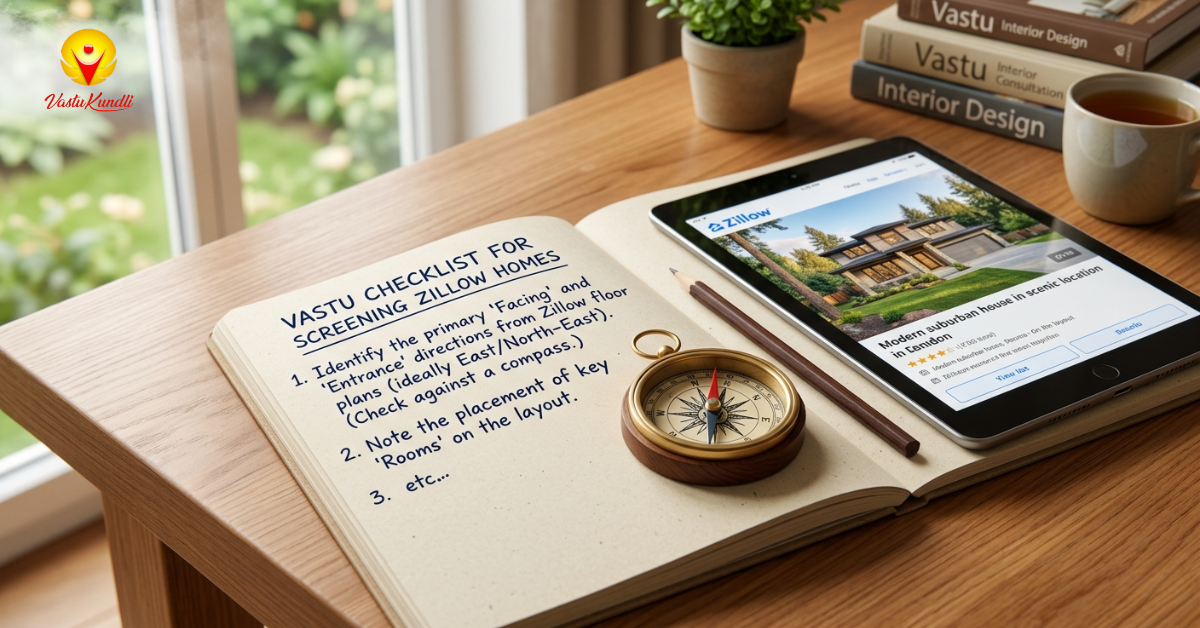
Searching for homes online has become the starting point for almost every property purchase in North America. You scroll through Zillow, Realtor, and Redfin, looking at hundreds of listings, saving favorites, and eventually scheduling tours for the properties that catch your eye. But here’s what most Indian families miss during this critical online research phase. Every listing contains enough Vastu information to screen out energetically problematic homes before you waste time falling in love with properties that will drain your family’s health, wealth, and harmony.
The typical buyer focuses on price, location, square footage, and how pretty the kitchen looks in photos. They check school ratings and calculate commute times. What they completely overlook is that the floor plans, photos, and property details in these online listings reveal the fundamental energy structure of each home. You can identify serious Vastu defects, spot promising energy patterns, and eliminate unsuitable properties all from your laptop before you ever drive to a single showing.
Nishant and Kriti spent three months browsing Denver listings on Zillow getting excited about different houses. They’d show each other beautiful photos, imagine their furniture in those spaces, and save dozens of favorites. They eventually toured twelve properties and made an offer on a gorgeous updated colonial that seemed perfect in every way. Only after moving in did they discover that the master bedroom sat in the southeast creating relationship tension, the toilet in the northeast was draining their financial opportunities, and the southwest entrance was limiting career growth. All of this was visible in the Zillow listing in the floor plan and photos but they hadn’t known how to read the energy story those elements were telling.
The power of applying Vastu principles during your online search phase is that it protects you from emotional attachment to energetically toxic homes. When you can screen listings systematically for directional alignment, room placement, and energy flow patterns, you eliminate properties with fundamental defects before you ever see them in person. You focus your limited tour time on homes that have genuine Vastu potential rather than discovering deal-breaking energy problems after you’ve already imagined your family thriving there.
Determining Directional Orientation from Online Information
Nothing matters more for Vastu evaluation than establishing the accurate directional orientation of a property. Which way does the home face. Where is north, south, east, and west relative to the structure? Without this foundational information, you cannot perform any meaningful Vastu analysis, regardless of how detailed the listing might be about other features.
The challenge is that most online listings don’t explicitly state directional orientation. Real estate agents don’t think to include this information because conventional buyers don’t ask for it. But the data you need is almost always available if you know where to look and how to extract it from the listing elements that are provided.
Start by examining any floor plans included in the listing. Many floor plans include a small compass rose or north arrow somewhere on the drawing, usually tucked in a corner or along the margin. This directional indicator is pure gold for Vastu screening. The moment you spot it, you can overlay the directional grid on the entire floor plan and begin evaluating which rooms occupy which zones. Northeast, northwest, southeast, southwest, and the four cardinal directions all become identifiable, allowing you to check kitchen placement, bathroom locations, bedroom positions, and entrance direction.
When listings don’t include floor plans or the plans lack directional indicators, turn to satellite and map views. Every real estate platform allows you to view properties from above using satellite imagery. Pull up this view and observe how the house sits on its lot. Note which direction the front of the house faces based on the street layout. Then use the compass feature built into Google Maps or your phone’s compass app to determine true north. By comparing the satellite view to compass directions, you can establish which wall of the house faces which direction, even without a labeled floor plan.
Street View features provide another orientation tool. Use Google Street View or the street view option on real estate platforms to see the front of the house from the road. Once you see which direction you’re looking at the house from and you know which direction that street runs using map tools, you can deduce the home’s orientation. If you’re looking at the front of a house while facing west and the house faces the street, then the entrance faces east. This simple logic helps you gather the directional data that the listing didn’t provide.
For properties you’re genuinely interested in, don’t hesitate to contact the listing agent with specific questions. Ask directly which direction the main entrance faces. Request floor plans with directional indicators if they’re not already posted. Many agents have additional documentation they can email that isn’t uploaded to public listings. A simple inquiry often provides exactly the orientation information you need for proper Vastu screening.
Reading Floor Plans Through the Vastu Energy Grid
When a listing includes a floor plan, you have your most powerful tool for remote Vastu evaluation. A floor plan is essentially an energy map if you know how to read it through Vastu principles. Every room placement, every bathroom location, every entrance, and every window tells part of the story about how energy will flow through this home and affect the family living there.
Begin by overlaying the eight-direction grid plus the center on the floor plan once you’ve established orientation. Mentally divide the plan into nine zones. The center is Brahmasthan. The eight surrounding zones are north, northeast, east, southeast, south, southwest, west, and northwest. Each zone has specific energy qualities and appropriate functions according to Vastu principles adapted for North American living.
Immediately check for toilets in the Brahmasthan or center zone. This is perhaps the most serious Vastu defect possible, and it’s completely visible on a floor plan. Draw diagonal lines from opposite corners of the overall house outline. Where they intersect marks the center. If any part of a bathroom occupies this central zone, that’s a fundamental energy problem affecting the entire property. Many older American homes were designed with central bathrooms for plumbing efficiency, creating this exact issue. Identifying it from the floor plan saves you from touring a property with an unfixable structural defect.
Evaluate bathroom and toilet placements throughout all zones. Bathrooms in the Northeast drain financial and spiritual energy. Toilets in the north weaken wealth accumulation. Bathrooms in the southwest can create instability and relationship challenges. Note every bathroom on the floor plan and assess whether its location creates energy drainage in critical zones. Remember that North American homes typically have multiple bathrooms, so you’re checking several placements, not just one.
Examine the kitchen location and orientation. Which directional zone contains the kitchen space? Based on the appliance symbols shown on the plan, in which direction would someone face while cooking? The southeast is traditionally favorable for kitchens as it aligns with the fire element. Northwest kitchens can create health and financial instability. Southwest kitchens may contribute to relationship tension. The floor plan reveals all of this if you know which zones to avoid and which support healthy kitchen energy.
Assess bedroom placements, especially the master bedroom zone. The southwest is generally supportive for the primary couple’s bedroom, promoting stability and grounding. Northwest bedrooms can create restlessness. Southeast bedrooms may cause tension due to excess fire energy. For children’s bedrooms, consider which zones support growth, learning, and peaceful rest. The floor plan shows you exactly which rooms occupy which zones, allowing you to plan room assignments before you even visit the property.
Check for entrance direction and quality. Where does the main door sit within the directional grid? The east and north entrances generally invite positive growth energy. The west and south entrances require more careful evaluation and possible corrections. Also, notice what sits immediately inside the entrance. Does the floor plan show the entry opening directly into the main living space, or is there a defined foyer creating a transition zone? Entrances that dump directly into living areas without buffer space create energy-rushing problems.
Look for diagonal alignment between front and back doors. If you can draw a straight line from the main entrance through the house to a back exit on the floor plan, that indicates piercing energy where positive flow enters and immediately exits without circulating. This is common in open floor plans, and it manifests as difficulty retaining wealth and feeling constantly restless or scattered.
Analyzing Listing Photos for Energy Flow Patterns
While professional listing photos are staged to look appealing, they actually reveal critical energy information if you examine them with Vastu awareness rather than just aesthetic appreciation. Every photo provides clues about spatial relationships, energy circulation, and potential Vastu concerns that you can identify before scheduling a tour.
Study photos for sightlines and openness. Can you see from the front of the house straight through to the back in any of the photos. This visual penetration indicates the piercing energy problem where entering energy doesn’t have barriers to slow it down and encourage circulation. Photos showing one room flowing directly into another without any definition suggest excessive openness that creates energy rushing. Conversely, images showing defined transitions between spaces with doorways, partial walls, or natural breaks indicate better energy containment and flow.
Notice what’s visible from the entrance area. Listing photos almost always include shots of the entry. Look carefully at what you can see beyond the entrance in these images. Is the kitchen visible immediately upon entering. Can you see a staircase facing the front door? Is there a bathroom within direct line of sight of the entrance. These elements visible in entry photos indicate energy challenges. The kitchen fire element shouldn’t be directly visible from where energy enters. Staircases facing entrances pull energy upward before it circulates. Bathrooms near entrances create immediate drainage of incoming positive flow.
Examine vertical relationships revealed in staircase and hallway photos. Sometimes you can identify bathrooms positioned above bedrooms by comparing door placements in upstairs hallway images to room layouts visible in downstairs photos. If an upstairs hallway photo shows a bathroom door positioned over an area where bedroom photos show beds below, that’s the vertical stacking problem where sleeping spaces are drained by waste energy above them.
Assess natural light quality throughout the home as shown in photos. Rooms flooded with natural light in multiple photos suggest good window placement and energy circulation. Spaces that appear dark despite professional photography indicate poor light flow, which correlates with stagnant energy. The northeast should ideally be light and open. If northeast rooms appear dark in photos, that’s an energy concern worth noting.
Look for clutter, blocked pathways, or cramped spaces visible even in staged photos. If the listing photos show tight hallways, cluttered corners, or spaces that feel compressed despite attempts to make them look good, the actual energy flow in person will be even more problematic. Good energy requires space to move. Cramped layouts visible in photos will feel oppressive energetically, regardless of the square footage numbers.
Extracting Vastu Insights from Property Details and Descriptions
The written descriptions and detailed sections of listings contain subtle Vastu information hidden within conventional real estate language. Agents describe features using marketing terms, but if you read these descriptions with Vastu understanding, you can identify energy concerns and positive factors the agent doesn’t realize they’re revealing.
When descriptions emphasize open concept living and great flow, this often signals the energy rushing problem. Agents highlight openness as a positive feature, but from a Vastu perspective, excessive openness without defined zones prevents energy from settling properly in different areas. Descriptions praising how you can see from one end of the house to the other or how all main rooms connect indicate a layout where energy enters and exits too quickly without nourishing individual spaces.
References to finished basements with bedrooms alert you to potential underground living situations. Basements are below-grade spaces with compressed earth energy. While they can serve certain functions well, using them as primary bedrooms, especially for children, requires careful consideration. The energy quality underground differs significantly from above-ground spaces and may not support rest and growth optimally.
Mentions of bonus rooms or rooms over garages indicate sleeping or living spaces positioned over voids. The garage is an empty space with vehicle energy and fumes. Bedrooms above garages lack a solid earth foundation beneath them, creating energetic instability that can affect sleep quality and overall grounding. When you see a bonus room highlighted in descriptions, investigate whether it sits over the garage and whether the family would use it as a bedroom.
Descriptions touting spa-like master bathrooms or luxurious en-suites often mean very large bathroom spaces within the master bedroom. While this sounds appealing, oversized bathrooms can create drainage in the relationship zone, especially if the bathroom occupies a large portion of the bedroom area or sits in a critical direction within that space. The proportion of bathroom to bedroom space matters energetically.
Notice what’s not mentioned in descriptions. If a listing emphasizes every possible feature but never references natural light, window quality, or room orientations, the home likely has lighting or directional issues the agent can’t frame positively. Descriptions focusing heavily on recent updates and finishes while saying little about layout and spatial quality might indicate problematic floor plans that the agent is working around.
Using the Year Built to Predict Common Vastu Patterns
The construction era of a property provides surprising predictive value for Vastu screening because building trends and standards have shifted over decades, creating patterns in how homes from different periods tend to be laid out. While every home is unique, knowing the year built helps you anticipate which Vastu issues to look for most carefully.
Homes built before 1970 often have more defined room separations with walls between functional areas. This traditional compartmentalized layout can be energetically favorable compared to extreme open concepts. Older homes typically have smaller bathrooms, which means less drainage area, though their placement within zones still requires checking. The downside is that older homes were sometimes designed with central bathrooms for plumbing efficiency, creating the Brahmasthan toilet problem. Pre-1970 homes warrant careful center zone checking.
Properties from the 1970s and 1980s represent a middle ground where ranch styles with good energy circulation were common. Many homes from this era have straightforward single-story layouts, easier to evaluate and optimize. Split-level designs also emerged during this period, creating vertical relationships that need checking. Kitchens in 1970s homes are often smaller and more enclosed than modern designs, which can actually be energetically positive depending on their directional placement.
1990s and 2000s construction saw the rise of two-story colonials and the beginning of open concept trends. Master suites over garages became common during this period, creating the bedroom-over-void issue. Central bathrooms remained popular in many designs. Homes from these decades often have larger footprints with more complex layouts requiring careful floor plan analysis to identify multiple potential Vastu concerns.
New construction from 2010 onward almost universally features extreme open concept layouts, oversized master bathrooms, bonus rooms over garages, and maximum square footage designs. These modern trends create predictable Vastu challenges. When screening very new homes, pay extra attention to checking for energy rushing in open plans, bathroom drainage in master suites, and bedroom-over-garage situations. The aesthetic appeal of contemporary design often masks energetic problems modern builders don’t consider.
Understanding these era-based patterns doesn’t mean you should automatically favor or avoid certain decades. It means you can screen more efficiently by knowing which issues to prioritize checking based on when a property was built. This speeds up your online evaluation process and improves accuracy.
Creating Your Systematic Vastu Screening Checklist
Browsing hundreds of listings becomes overwhelming without a structured evaluation system. You need a repeatable checklist you can apply quickly to each property, separating genuine candidates from energy disasters before you waste emotional energy or schedule tours for homes with fundamental defects.
Develop a quick scoring framework for the key Vastu factors assessable from online information. For each listing you seriously consider, evaluate the entrance direction, noting whether it’s favorable or requires correction planning. Check the center zone for bathroom placement, which is pass or fail. Assess the kitchen zone as supportive, neutral, or problematic. Review all bathroom placements for drainage concerns. Evaluate the master bedroom zone for relationship support. Note the overall energy flow based on the floor plan and photos as open and rushing, well-contained, or blocked and stagnant.
Homes that score favorably on most factors go on your tour list with notes about which elements to verify in person. Properties that fail multiple critical factors get eliminated immediately, regardless of how beautiful the granite countertops are or how much you love the neighborhood. Homes with one or two correctable issues and otherwise good energy structure get flagged as possibilities if corrections seem reasonable.
Maintain organized documentation for properties that pass your screening. Save floor plans with your directional analysis marked on them. Screenshot photos showing key energy features or concerns. Write notes about what attracted you energetically and what questions you need to investigate during an in-person tour. This creates a reference library you can review when comparing multiple candidates and making final decisions.
Share your screening approach with your partner, so you’re applying consistent Vastu criteria. When couples browse independently without a shared evaluation framework, they end up debating properties based on different unstated assumptions. Having an explicit Vastu checklist creates a common language for discussing which homes genuinely serve your family’s energy needs versus which just look pretty in photos.
Refine your screening system over time as you gain experience. Your first attempts might miss subtle issues or overweight factors that turn out to be less critical. As you tour properties, get professional consultations, and learn from experience, update your checklist to focus on what matters most for your specific family and what’s most reliably assessed from online information.
Recognizing When Remote Screening Reaches Its Limits
Online Vastu screening is powerful for eliminating obviously problematic properties and identifying promising candidates, but it has inherent limitations. Understanding what you can and cannot determine remotely helps you know when a property requires in-person investigation before a confident evaluation is possible.
You cannot assess the felt energy of a space from photos and floor plans. How does it actually feel when you walk through the front door? Does the master bedroom have a restful quality, or does it feel agitated? Is there oppressive energy in certain corners, or does light circulate beautifully, creating vitality? These experiential qualities affect how your family will thrive in the home, and they require physical presence to evaluate properly.
The accuracy of listing information varies enough that you cannot fully trust details without verification. Floor plans might be outdated, not reflecting the renovations previous owners made. Photos might be from before the current owners changed things. Compass orientations you calculate from satellite views might be slightly off, especially if the satellite image is old or the lot has unusual positioning. For properties passing your online screening, in-person verification of the assumptions you made remotely is essential.
Sometimes you can identify potential problems from listings, but they lack sufficient detail to determine severity. You might spot what appears to be a bathroom in a concerning zone, but you can’t tell from the floor plan exactly where the fixtures sit within that space. You might see elements in photos suggesting energy rushing, but you can’t confirm without walking through and experiencing the actual flow. These question marks require either requesting additional documentation from the agent or touring the property with your Vastu concerns in mind.
Properties that pass your remote Vastu screening deserve an in-person evaluation to confirm your assessments and check factors you couldn’t evaluate online. Bring your annotated floor plan and notes from online research. Walk through deliberately, verifying directional elements; assessing energy quality in person; and checking details the listing didn’t reveal. Your online screening got you to qualified candidates. Your in-person tour confirms whether they actually work for your family’s specific needs.
Learn 5 Essential Vastu Checks Before Buying a Home
Even before consulting an expert, families can perform 5 essential checks themselves:
- House Facing Issues – The direction your home faces affects overall energy and growth.
- Entrance Quality Mistakes – The main door controls how positive energy enters the house.
- Kitchen Placement Conflicts – Wrong kitchen direction can disturb health and finances.
- Toilet Placement Problems – Poor toilet location can weaken wealth and health zones.
- Bedroom Placement Problems – Incorrect bedroom zone can affect sleep and relationships.
These simple checks are just the start. To learn them in depth, with practical applications for homes in the USA and Canada:
Join our live course “5 Essential Vastu Checks Before Buying a Home.”
This course will guide you step-by-step to evaluate any property before making a purchase, helping you avoid mistakes that lead to stress, financial strain, and family discomfort. Families who take this course leave with actionable insights they can implement immediately whether they’re buying a new home or checking an existing property.
Go to the course section and join our live course today to gain major Vastu insights for every home decision.
Book Your Comprehensive Vastu Health Report
For families ready to buy or even after selecting a property, our Vastu Health Report is invaluable. Unlike a casual consultation, this report examines 30-plus critical parameters of your home, including main door alignment and entrance energy, kitchen orientation and placement, bedroom and study room energy, clutter and lighting analysis, and hidden energy zones affecting health, wealth, and relationships.
By checking all these parameters, families can identify and correct energy blockages before moving in, ensuring long-term harmony, prosperity, and well-being.
Book your personalized Vastu Health Report in the consultation section today because your home should nurture your family, not drain it.
About Our Vastu Expert – Gaurav Jindl
Gaurav Jindl specializes in teaching families efficient online Vastu screening systems for North American real estate platforms. He understands that modern home shopping begins digitally and that families need practical methods for applying directional and energy principles during their online research before investing time and emotional energy in property tours.
His approach maximizes what you can reliably determine from listing information while being honest about remote evaluation limitations. He provides clear frameworks for reading floor plans through the directional grid, interpreting photos for energy flow patterns, and extracting Vastu insights from property details and descriptions that weren’t written with energy considerations in mind.
Families working with Gaurav develop the ability to screen 20 to 30 listings in the time it previously took them to tour 2 or 3 homes. This efficiency comes from knowing which Vastu factors are assessable from online data and which require in-person verification. The result is spending limited tour time only on properties with genuine energy potential rather than discovering fundamental defects after you’ve already imagined your family thriving there.
Practical Advice for Families in the USA
Set up saved searches on multiple platforms to maximize the listing information you can access. Zillow, Realtor, Redfin, and local MLS sites sometimes have different photos, floor plans, or property details for the same homes. Checking multiple sources gives you more complete data for Vastu screening.
Bookmark or save properties that pass your Vastu screening with notes about why they qualified and what concerns need in-person checking. Most platforms let you add private notes to saved listings. Use this feature to record your directional analysis, zone evaluations, and questions to investigate during tours.
Don’t let emotional reactions to beautiful photos override systematic Vastu evaluation. Pretty staging and professional photography trigger desires for homes, but those feelings can cloud judgment about energy suitability. Force yourself to complete your directional analysis and zone checking even for listings that immediately appeal to you aesthetically.
Remember that online screening is elimination, not final selection. Your goal during digital research is to remove properties with serious Vastu defects and identify candidates worth deeper investigation. Final decisions come after physical tours, direct energy assessment, and possibly professional consultation. Online screening protects your time and emotional energy by focusing efforts on genuinely suitable properties.
Final Thoughts
Nishant and Kriti now approach Zillow searches completely differently than during their first home purchase. They systematically check directional orientation, overlay the Vastu grid on floor plans, assess zone placements, and evaluate energy flow from photos before saving any listing as a favorite. They request floor plans from agents for properties they’re seriously considering and verify compass directions using satellite views and maps. This disciplined Vastu screening has prevented them from touring homes with fundamental energy defects and falling in love with properties that would recreate the problems they’re experiencing in their current house.
The power of online Vastu screening is that it prevents wasted time and protects emotional well-being. When you can eliminate homes with center bathrooms, unfavorable entrance directions, problematic kitchen zones, and energy-rushing layouts before touring them, you’re left with a manageable pool of candidates that all have decent Vastu structures. Your in-person visits become about confirming good energy and choosing among qualified options rather than discovering deal-breaking defects after you’ve already invested hope.
Online real estate platforms provide unprecedented access to floor plans, photos, and details that contain complete Vastu information if you know how to extract it. Learning to read listings through the directional grid and energy flow principles transforms house hunting from emotional overwhelm into strategic screening. You become an informed shopper who understands the energy story each property is telling, and that knowledge serves your family’s long-term harmony, prosperity, and well-being far better than any luxury finishes or trendy design features.
Frequently Asked Questions
Q. Can I accurately evaluate Vastu from online listings, or do I need to visit every property in person?
A. You can screen for major directional defects and zone placement problems using floor plans and listing information, but a final energy assessment requires in-person experience. Use online screening to eliminate unsuitable properties and identify qualified candidates, then tour those candidates to confirm energy quality and verify your remote analysis.
Q. What if the listing has no floor plan and the agent won’t provide one?
A. Without a floor plan, your confidence level drops significantly. You can gather some directional information from satellite views and extract clues from photos, but you cannot perform systematic zone analysis. Consider these listings lower priority unless other factors make them compelling enough to tour speculatively, with plans to request floor plans if the energy feels good in person.
Q. Should I skip touring homes that fail my Vastu screening even if they’re otherwise perfect for location and price?
A. If a property has fundamental unfixable defects like toilets in the Brahmasthan or severe zone placement problems you’ve confirmed from floor plans, it’s reasonable to skip tours and focus time on energetically suitable options. However, if you have very limited inventory in your market, a tour might reveal that the issue is less severe than it appeared online or that other positive factors outweigh the concern.
Q. How strictly should I apply Vastu principles when screening online listings?
A. Prioritize checking for fundamental defects like center bathrooms, severely unfavorable entrance directions, and major zone placement problems. Be more flexible about minor directional concerns or issues that can be corrected through room assignment changes and furniture placement. The goal is to eliminate homes with serious energy problems while remaining realistic about North American construction patterns.
Q. What’s the best way to organize my Vastu screening results across many listings?
A. Create a simple spreadsheet or document tracking each serious candidate with columns for address, entrance direction, kitchen zone, bathroom placements, master bedroom zone, energy flow notes, and overall Vastu score or rating. This lets you compare multiple properties systematically and reference your analysis when scheduling tours or making offers.
