
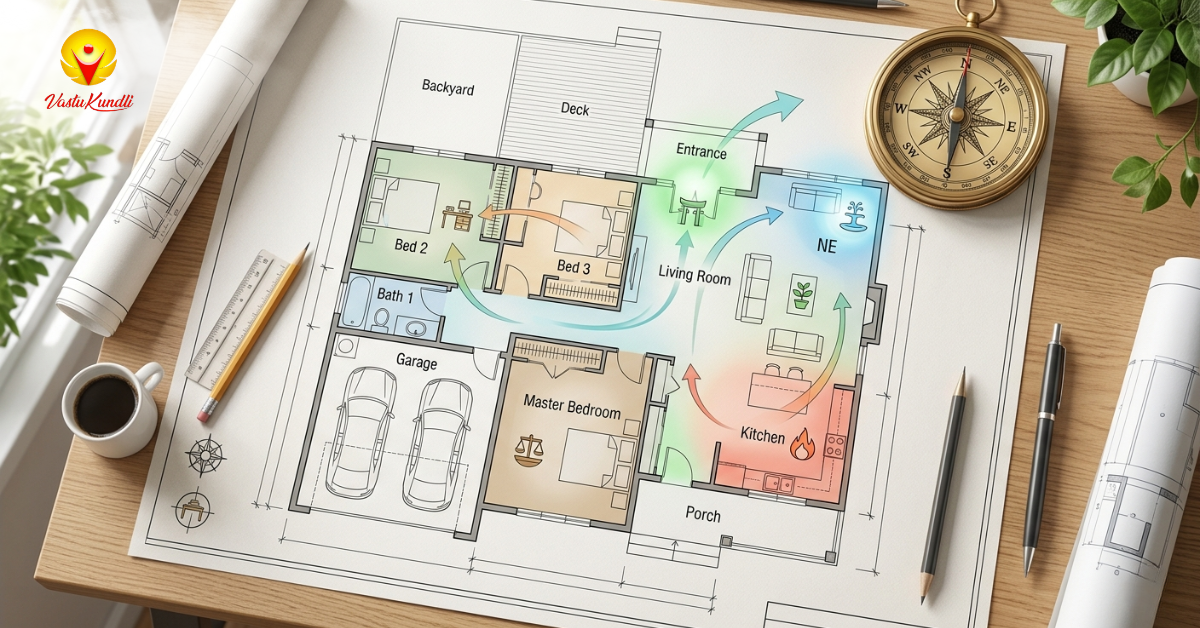
Most Indian families moving to the USA or Canada feel overwhelmed when they start house hunting. The floor plans look completely different from what they grew up with back home. Open-concept layouts, split-level designs, attached garages, finished basements, and rooms with purposes they’ve never encountered before, like bonus rooms, mudrooms, and walk-in pantries. The architectural language itself feels foreign. And when you try to apply traditional Vastu knowledge to these modern North American designs, nothing quite fits the way you expect it to.
The floor plans builders hand you during property tours are technical drawings meant to show square footage and room dimensions. They’re not designed to reveal energy flow patterns or directional implications. Most buyers look at these plans and focus on whether the bedrooms are big enough, if there’s sufficient storage, and whether the layout feels functional for their family. What they miss are the energy signatures hidden in plain sight on those drawings that will determine whether this home supports their prosperity and well-being or slowly drains it over the years of living there.
Harsh and Ishita learned this gap the hard way. They bought a house in Seattle after carefully reviewing the floor plan and feeling good about the room sizes and general layout. They even checked the compass direction the house faced and noted where the kitchen was located. But they didn’t understand how to read the complete energy story that the floor plan was telling. They missed that the master bedroom sat directly over the garage, creating an energetic void beneath their sleeping space. They didn’t recognize that the open floor plan created piercing energy from front to back with no barriers to slow positive flow. They saw a powder room near the entrance, but didn’t realize its exact placement weakened the wealth zone.
Six months into living there, both were experiencing chronic fatigue despite adequate sleep hours. Their toddler developed persistent respiratory issues that the pediatrician couldn’t fully explain. Money seemed to evaporate faster than it should have, given their stable dual income. When they finally got a comprehensive Vastu evaluation, the consultant pointed to issue after issue on their floor plan that they’d looked at dozens of times but never truly understood. They had the drawing in their hands all along but didn’t know how to read what it was actually showing them about the home’s energy structure.
Understanding the Compass Orientation First
Before you can evaluate any floor plan from a Vastu perspective, you absolutely must know the directional orientation of the property. This is the foundation everything else builds on. Most American floor plans show a north arrow somewhere on the drawing, usually in a corner or along the margin. This arrow tells you how the home sits on its lot relative to true north. Without this information, you cannot perform any meaningful Vastu analysis.
The challenge is that many buyers skip right over this compass indicator or don’t understand its significance. They look at the pretty drawing of rooms and furniture placement without first establishing which direction is which. This is like trying to navigate with a map but not knowing which way you’re holding it. You need to orient the floor plan properly in your mind before you can start evaluating whether specific rooms are in supportive or problematic zones.
Once you locate the north arrow, mentally rotate the entire floor plan so that north points upward in your mind’s eye. This might mean turning the physical paper or screen until north is at the top. Now you can start dividing the plan into directional zones. The north zone is at the top, the south at the bottom, the east to the right, and the west to the left. The corners are northeast, northwest, southeast, and southwest. Every room, bathroom, entrance, and feature now has a directional location you can evaluate.
Some floor plans don’t include compass orientation, which creates a serious problem for Vastu analysis. If you’re looking at properties in person, bring a compass or use a compass app on your phone to determine directions yourself. Stand inside the home or on the property and note which direction the front of the house faces. Mark this on your floor plan copy so you have the information you need for proper evaluation. Don’t assume that the front of the house faces the same direction on every lot in a development. Builders often rotate plans based on street layouts.
Identifying Main Entrance and Energy Entry Points
American homes often have multiple potential entry points, which creates confusion when determining the main entrance from a Vastu perspective. There’s typically an architectural front door that faces the street. There’s often a side door leading from the garage or driveway. Some homes have back doors or patio entrances. The question becomes which entrance actually functions as the main energy entry point for your family.
The traditional answer is that the main entrance is whichever door you use most frequently for coming and going. In many North American homes, families enter primarily through the garage and rarely use the formal front door except when guests visit. From an energy perspective, your daily entrance is more significant than the architectural entrance. The door that receives the majority of your traffic is where the majority of energy enters your home.
When reading a floor plan, locate all potential entrances and note their directional positions. If the front door faces south but you’ll actually enter daily through a garage door that opens to the north, the north entrance is your energetic main door. This distinction matters enormously because you’re evaluating the energy quality of your actual entry point, not the door the builder designated as primary for aesthetic or street appeal purposes.
Also notice what happens immediately inside each entrance. Does the door open directly into the main living space, or is there a foyer or transition area? American open floor plans often have front doors that open straight into the living room with no buffer zone. This creates energy that rushes in without space to settle and organize itself. Floor plans that show a defined entry area, even a small one, are energetically preferable because entering energy has room to adjust before flowing into your living spaces.
Decoding Open Concept Layouts
The open-concept floor plan is perhaps the biggest difference between traditional Indian homes and modern American construction. Where Indian homes typically have defined separate rooms, American homes, especially newer construction, feature large open spaces where kitchen, dining, and living areas flow together without walls. Reading these layouts requires understanding how energy moves through undefined space.
Look for any elements that create natural divisions, even in open plans. A kitchen island, a change in flooring material, a half wall, and a furniture arrangement shown on the plan indicate where energy might slow down or shift even without full walls. Plans that show absolutely nothing breaking up a massive open space from front to back create the energy-rushing problem where positive flow enters and exits too quickly without circulating properly.
Pay attention to sightlines indicated by the layout. If the floor plan shows that someone standing at the front entrance can see directly through to the back door or patio, that’s the piercing energy concern. If the kitchen stove is visible from the front entrance, that’s another issue where the fire element of cooking is too exposed to entering energy. These sightline problems aren’t always obvious from the drawing, but if you trace imaginary lines of sight through the open spaces, you can spot them.
Consider how you might create energetic boundaries in open layouts using furniture, area rugs, or portable screens. When evaluating a floor plan, think about where you could place these elements to guide energy flow, even though the walls don’t. A well-placed sofa can redirect energy just as effectively as a half wall. Area rugs can define zones within larger spaces. Making notes on the floor plan about where you’d add these elements helps you envision how to work with the open concept rather than being defeated by it.
Reading Vertical Layouts and Multi-Story Issues
North American homes frequently have multiple stories with bedrooms upstairs and living areas downstairs or with split-level designs that have rooms at different elevations. Reading these vertical relationships on a floor plan requires looking at multiple drawing sheets and understanding what’s positioned above or below what. This spatial thinking doesn’t come naturally when you’re used to single-story homes.
The most critical vertical relationship to check is whether bathrooms sit above bedrooms. Many American builders stack bathrooms vertically for plumbing efficiency. If the floor plan shows a bathroom on the second floor directly over a first-floor bedroom, that’s a serious energy drainage issue. The person sleeping below is being drained by water and wasted energy flowing above them. You need to compare the upstairs and downstairs plans carefully to spot these stacking problems.
Another common issue is bedrooms located above garages. American attached garages are often positioned such that a bedroom sits over the garage space. The floor plan might show this as a bedroom with an asterisk or note indicating it’s over the garage, or you might need to compare the first-floor garage footprint to the second-floor bedroom layout to identify this situation. Sleeping over an empty void with vehicle energy and fumes below creates energetic instability that affects rest and health.
Basement layouts add another layer of complexity. Many North American homes have finished basements with additional bedrooms, family rooms, or home offices. These spaces are partially or fully below ground level, which changes their energy characteristics compared to above-ground rooms. When reading floor plans with basements, note which spaces are underground and consider whether placing bedrooms or primary living areas there will work for your family’s energy needs.
Evaluating Kitchen Placement in Modern Designs
American kitchens are typically much larger than traditional Indian kitchens and often include islands, breakfast nooks, and open connections to dining and living areas. Reading the kitchen on a floor plan means understanding not just where the room is located directionally, but also where within that room the actual cooking happens and how the space connects to the rest of the home.
Locate the stove or cooktop symbol on the floor plan, which usually appears as a small rectangle or specific icon. This is the fire element’s primary location. Note which direction this sits in and which direction someone would face while cooking based on how the stove is oriented. Many modern plans show the stove on an island facing into the room rather than against a wall, which creates different energy dynamics than traditional setups.
Notice if the kitchen is visible from the main entrance. Many open concept plans position the kitchen such that it’s the first thing seen when entering the home. This creates issues with the fire element of cooking being too exposed to entering energy, and can contribute to financial drainage. Floor plans that show the kitchen tucked to one side or partially screened from the entrance are energetically preferable.
Also, evaluate the kitchen’s position relative to the bathrooms. Ideally, the kitchen shouldn’t share a wall with a bathroom, especially where the stove is located. American homes sometimes place a powder room adjacent to the kitchen for convenience without considering the energetic conflict between fire cooking energy and water waste energy. Looking at the floor plan carefully helps you spot these adjacency problems before they affect your family’s health and finances.
Identifying Bathroom and Toilet Placements
American homes typically have multiple bathrooms distributed throughout the house, which creates more complexity for Vastu evaluation. You’re not just checking one bathroom placement but rather ensuring that none of the bathrooms occupy particularly problematic zones or create drainage in critical areas. Floor plans use standard symbols for toilets, tubs, showers, and sinks that you need to learn to read quickly.
The most important check is whether any bathroom occupies the center of the home, which is the Brahmasthan. To find the center, draw diagonal lines from corner to corner of the overall floor plan outline. Where they intersect is the center point. If a bathroom sits here or very close to here, that’s a fundamental defect that affects the entire property’s energy. Unfortunately, many older American homes were designed with central bathrooms for plumbing efficiency without any awareness of this concern.
Also note the bathrooms in wealth zones, particularly the north and northeast areas. These directions are associated with prosperity and opportunity. Having bathrooms there, especially in prominent positions, creates energy drainage in your financial areas. Small powder rooms are less problematic than full bathrooms with tubs and showers, but all bathrooms in these zones require attention and possible correction strategies.
Check for toilet placement behind or very close to the stove or bed headboard. Floor plans sometimes show these unfortunate arrangements where a bathroom on one side of a wall sits right where the kitchen stove or a bedroom bed would logically be placed on the other side. These create direct energetic conflicts that are harder to correct than general directional issues.
Understanding Bedroom Zones and Sleep Spaces
American floor plans typically show bedrooms as simple rectangles without furniture, but you need to visualize where beds would actually be positioned within those rooms and which direction the person sleeping would orient. This requires understanding that Americans typically place beds against walls with headboards rather than in the center of the room and that bed size affects options for positioning.
First, identify which bedroom will serve as your master bedroom and check its directional zone. The master bedroom placement affects the primary couple’s relationship, health, and overall life trajectory. Bedrooms in certain zones support rest and intimacy, while others create restlessness or conflict. Note whether the master bedroom is in a supportive location or whether you might consider using a different bedroom as the master to optimize energy.
For children’s bedrooms, consider which zones support growth, learning, and healthy development. Different children might thrive better in different rooms based on their individual needs and the room’s directional energy. When reading a floor plan, think about assigning specific rooms to specific family members based on energy optimization rather than just choosing based on size or bathroom access.
Also, evaluate whether bedrooms have ensuite bathrooms and where those bathrooms are positioned relative to the bed space. American master bedrooms almost always include attached bathrooms. The location of this bathroom within the bedroom space matters. A bathroom directly in line with where the bed would sit creates drainage concerns. Bathrooms tucked into corner zones are generally less problematic.
Learn 5 Essential Vastu Checks Before Buying a Home
Even before consulting an expert, families can perform 5 essential checks themselves:
- House-Facing Issues – The direction your home faces affects overall energy and growth.
- Entrance Quality Mistakes – The main door controls how positive energy enters the house.
- Kitchen Placement Conflicts – The wrong kitchen direction can disturb health and finances.
- Toilet Placement Problems – Poor toilet location can weaken wealth and health zones.
- Bedroom Placement Problems – An incorrect bedroom zone can affect sleep and relationships.
These simple checks are just the start. To learn them in depth, with practical applications for homes in the USA and Canada:
Join our live course “5 Essential Vastu Checks Before Buying a Home.”
This course will guide you step-by-step to evaluate any property before making a purchase, helping you avoid mistakes that lead to stress, financial strain, and family discomfort. Families who take this course leave with actionable insights they can implement immediately whether they’re buying a new home or checking an existing property.
Go to the course section and join our live course today to gain major Vastu insights for every home decision.
Book Your Comprehensive Vastu Health Report
For families ready to buy or even after selecting a property, our Vastu Health Report is invaluable. Unlike a casual consultation, this report examines 30-plus critical parameters of your home, including main door alignment and entrance energy, kitchen orientation and placement, bedroom and study room energy, clutter and lighting analysis, and hidden energy zones affecting health, wealth, and relationships.
By checking all these parameters, families can identify and correct energy blockages before moving in, ensuring long-term harmony, prosperity, and well-being.
Book your personalized Vastu Health Report in the consultation section today because your home should nurture your family, not drain it.
About Our Vastu Expert – Gaurav Jindl
Gaurav Jindl has extensive experience helping families translate between traditional Vastu principles and modern American floor plans. He understands that North American architectural conventions create unique challenges requiring adapted evaluation methods rather than rigid application of traditional rules designed for completely different building styles.
His teaching approach focuses on empowering families to read floor plans independently so they can screen properties during house hunting before investing in detailed consultations. He provides clear frameworks for interpreting modern layouts, identifying the most critical issues to check, and understanding which problems are deal-breakers versus which can be managed through simple corrections.
Families working with Gaurav learn to evaluate properties quickly and confidently using floor plans they can request from listing agents or builders before ever visiting properties in person. This saves enormous time and prevents emotional attachment to homes that have fundamental energy defects that would require living with ongoing problems or expensive corrections.
Practical Advice for Families in the USA
Always request floor plans before touring properties whenever possible. Many listings include plans in online marketing materials. For new construction, builders readily provide plans. Having the drawing in hand or on your phone during tours allows you to orient yourself and verify directional elements as you walk through the actual space.
Learn the standard floor plan symbols used in American architectural drawings so you can quickly identify elements. Rectangles with arcs indicate door swings. Specific icons show appliances. Dashed lines often indicate features above, like upper cabinets or structural beams. Understanding this visual language helps you read plans faster and more accurately.
Practice overlaying the directional grid on sample floor plans until it becomes second nature. The more plans you evaluate, the faster you’ll spot common issues like center bathrooms, front-to-back energy rushing, or bedrooms over garages. This skill improves with repetition, so review many plans even for properties you’re not seriously considering.
Make notes and marks directly on floor plan copies as you evaluate them. Circle problematic areas, draw arrows showing energy flow, and mark which rooms you’d assign to which family members. These annotated plans become valuable references when comparing multiple properties and making final decisions about which homes best support your family’s needs.
Final Thoughts
Harsh and Ishita now know how to read American floor plans with Vastu awareness. They’re currently house hunting again, this time armed with knowledge they lacked during their first purchase. They can look at a floor plan online and, within minutes, identify the major energy issues without even visiting the property. This has saved them countless hours touring homes that would have created problems and allowed them to focus attention on properties with good fundamental energy structure that they can optimize through simple adjustments.
The skill of reading floor plans from an energy perspective is learnable and doesn’t require years of study. You need to understand the directional framework, know which placements create which types of issues, and practice applying this knowledge to the specific floor plan conventions used in North American construction. Once you have this foundation, every floor plan becomes a readable energy map rather than just a collection of room dimensions.
Your ability to evaluate homes effectively during the searching phase prevents you from falling in love with properties that will drain your family’s well-being. Floor plans tell you the energy story before you invest time, emotion, and money into homes that have fundamental problems. Learning to read that story is one of the most valuable skills you can develop as you navigate the North American housing market while honoring the wisdom of Vastu principles.
Frequently Asked Questions
Q. What if the floor plan doesn’t show a compass direction?
A. Bring a physical compass or use a compass app when visiting the property to determine orientation yourself. You can also use online satellite maps to identify which direction the front of the house faces based on street layout. Never evaluate a floor plan without knowing directional orientation.
Q. How do I evaluate townhouses where I only own the interior space?
A. Treat your unit as the complete property for analysis purposes. The directional zones exist within your unit boundaries just as they would in a detached home. Shared walls don’t change the internal directional grid. Apply the same evaluation process to your unit’s floor plan.
Q. Can I trust the room labels on builder floor plans?
A. Use room labels as general guidance, but remember you control how you actually use each space. A room labeled as bedroom can function as an office or study if that assignment creates better energy for your family. Focus on directional placement and optimization rather than accepting builder room designations as fixed.
Q. What if I see problems on the floor plan but love everything else about the property?
A. Determine whether the problems are fundamental defects like center bathrooms that can’t be adequately corrected or whether they’re issues you can address through room purpose changes, furniture placement, and other non-structural methods. Get a professional evaluation to understand your actual correction options before walking away from a property.
Q. Do floor plan evaluation skills replace the need for professional Vastu consultation?
A. Floor plan reading helps you screen properties and make better initial choices, but a comprehensive evaluation still benefits from professional expertise, especially for complex layouts or when you’re deciding between multiple acceptable options. Think of floor plan skills as empowering you to eliminate obvious problems while professional consultation optimizes the final selection.
